

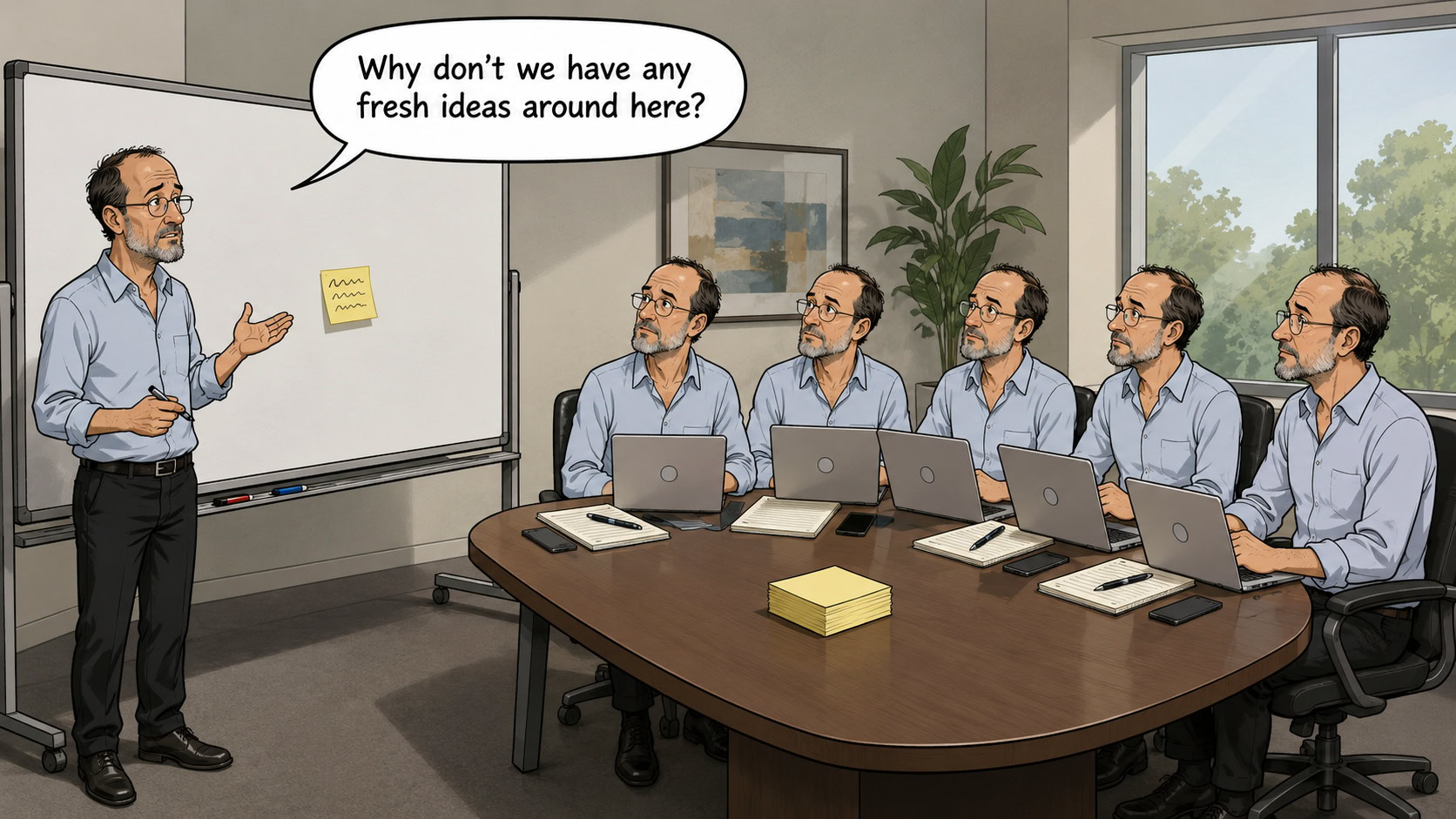
Some school boards are racked with conflict and division. Other boards face the opposite situation, with every board member agreeing harmoniously on everything without discussion or dissent. Both situations are actually serious problems.
I have discussed conflict and division in other articles such as Conflict Resolution and Mediation. Here I want to focus on the equally significant, but perhaps surprising, problem of universal harmonious consensus.
As I wrote in Buridan’s Donkey, effective board meetings occur when there is a conflict of ideas, but not a conflict of people. If everyone agrees on every point of every discussion, there is very little functional value in having a board at all. The point of bringing people together is to bring different perspectives into a single forum where people can share their own viewpoints respectfully, listen to one another, and then revise, refine and fine-tune their own opinions in order that the wisdom of the final decision exceeds that of any one person’s single perspective.
Unfortunately, some boards I have worked with fall short of this ideal and instead descend into groupthink. At its simplest, groupthink occurs when a group of people (such as a school board) suppress doubts, overlook risks and/or unquestioningly accept a prevailing or dominant viewpoint to make irrational, flawed, or poorly thought-through decisions. Groupthink arises because every person present in a meeting values harmony and conformity above critical thinking. Indeed, I have seen school board meetings where the blind loyalty of friendships has served as the single most morally corrupting influence in the discussion.
Groupthink shuts down creativity and diverse viewpoints. It typically occurs when:
a highly cohesive group with similar backgrounds, training or ideologies,
who perceive threats from people outside the group,
but who may be overtly or secretly competitive within the group to achieve glory, fame or fortune,
and who may therefore knowingly or unknowingly violate proper processes or ethical standards,
will
develop a belief in the morality of the group,
convince themselves of the correctness of their own views,
stereotype out-groups, and
place pressure on dissenters,
leading to:
distortion of objectives,
dismissal of alternatives,
poor information search,
selective bias in processing information,
failure to reconsider originally rejected alternatives,
failure to examine costs and risks of the preferred choice, and
failure to work out viable implementation, monitoring, and implementation plans.
Overcoming groupthink can be one of the most important, yet difficult, problems for a school board to fix. The difficulty arises because most school boards function in a highly relational (as opposed to transactional) manner, and members fear that disagreeing with a friend or colleague may cause uncomfortable relational problems. Indeed, it is a sad commentary on some boards that its members value conflict avoidance in a board meeting more highly than educational quality or students’ welfare.
The first defence against groupthink is therefore for the Chair to make constructive dissent an explicit board responsibility. The Chair should regularly remind members that their duty is not to support colleagues or avoid disagreement, but to make the best decision for the school and its students. Questions such as “What might we be missing?”, “What evidence would challenge this conclusion?” and “What are the strongest arguments against this proposal?” should become routine.
The Chair also has an important role in structuring discussions so that independent thinking occurs before consensus forms. Rather than asking, “Does everyone agree?”, board members can initially be asked to consider an issue individually and write down their views confidentially before discussion begins. For significant decisions, the Chair can deliberately invite the least-heard voices to contribute first and ensure that dissenting opinions are properly explored. It can also be useful to appoint a “devil’s advocate”, or “red team”, whose formal responsibility is to challenge the emerging recommendation. The aim is not to create artificial conflict, but to ensure that disagreement is examined rather than suppressed. De Bono’s Six Thinking Hats can be a very helpful technique to use here (see my article Consensus Building - six approaches).
Boards should also broaden the information on which decisions are based. Management should not be the board’s only source of information, particularly when the board is evaluating management performance or considering a major strategic decision. Independent expert advice, benchmarking against comparable schools, surveys of relevant stakeholders, financial analysis and alternative scenarios can expose assumptions that have become accepted as facts. Importantly, boards should distinguish between information that confirms the preferred option and information that genuinely tests it, and encourage consideration of both.
A strong defence against groupthink is ensuring diversity in board composition. Not all boards have control over their own composition because of constraints in their own Constitution, obligations to accept nominees from outside bodies, and in some cases, Acts of Parliament. Irrespective of these constraints, it is very clear that boards with members from diverse backgrounds and characteristics – gender, age, culture, preferred learning style, etc – are more creative and less prone to groupthink than boards whose members could almost be clones of each other. This is explored more fully in Diversity enhances effective school board leadership and Generational differences affect educational leadership.
Finally, the board should develop a culture of psychological safety and disciplined review. Members must be able to say, “I disagree,” or “I think we are making a mistake,” without being labelled disloyal or difficult, and without fearing relational challenges. After major decisions have been concluded, the board can conduct a short decision review, asking questions such as “What assumptions did we make?”, “What did we get right?”, “What did we overlook?”, and “Would we make the same decision today?”. Although it may not always be comfortable, such practices can be highly effective in converting disagreement into a governance asset.
As we saw above, Groupthink leads to self-censorship, an illusion of uniformity and invulnerability, strong pressure to conform and shared rationalisation. On the other hand, a healthy board is not one in which everyone agrees; it is one in which members express their opinions openly, examine the evidence rigorously, disagree agreeably, and then commit collectively to the decision reached.
- Dr Stephen Codrington
We offer support for school leaders and board members in many areas, such as workshops and individual advice on board dynamics, including meeting dynamics.
Further information on this and many other facets of best practice in school leadership and governance is provided in the books “Optimal School Governance", and “DARING INSIGHTS into School Leadership and Board Governance”, which can be ordered directly through Pronins.
You may also be interested in previous articles which are archived at https://optimalschool.com/articles.html. You can subscribe to receive future articles by e-mail using the red button below.