

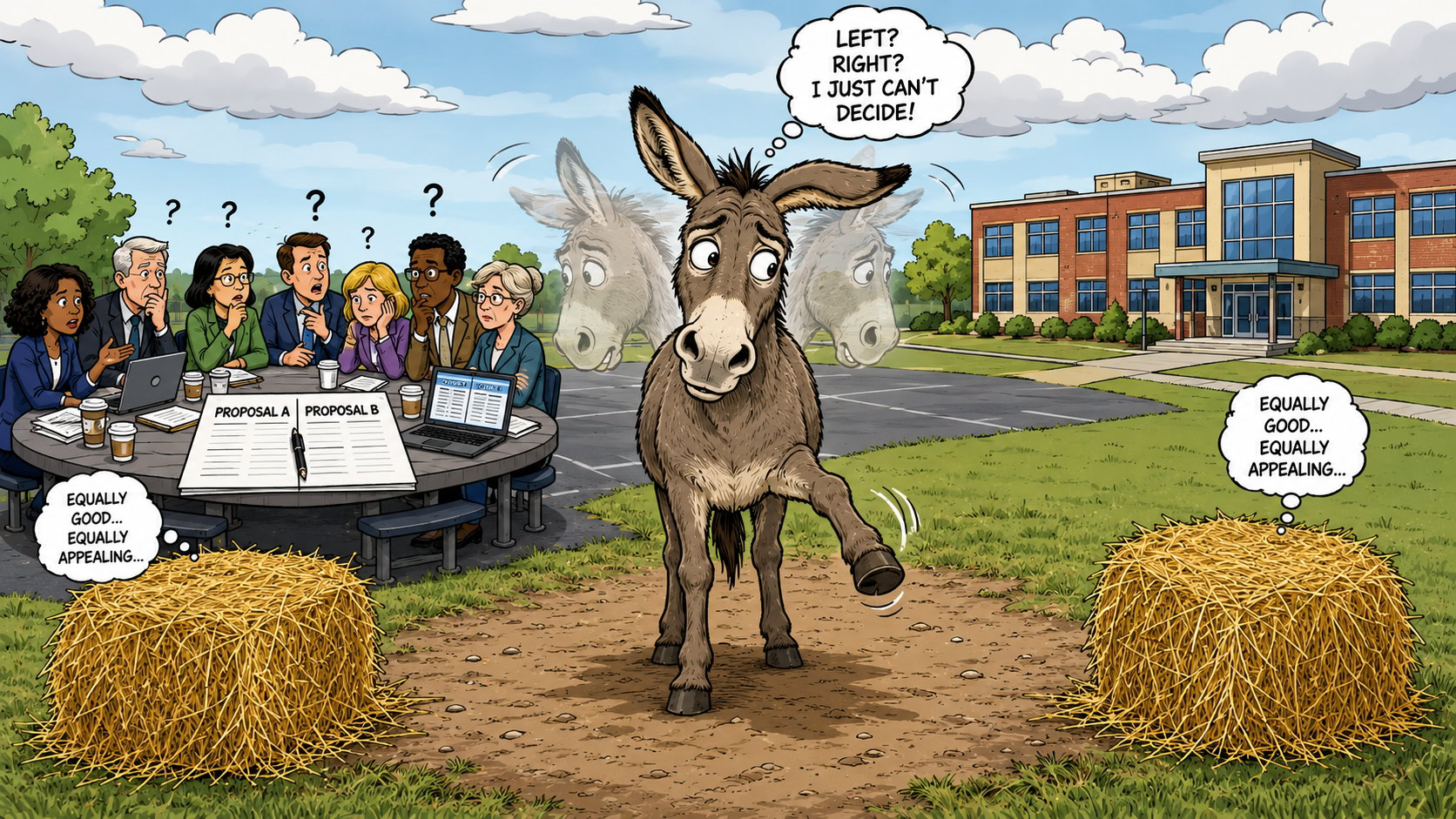
Buridan’s Donkey represents the paralysis of decision-making which can arise among members of a school board (or indeed anyone!) when they are confronted by two identical, equally appealing choices.
The thought experiment featuring the now-famous donkey was first proposed by the French philosopher, Jean Buridan, in the 1300s, although the concept underpinning it dates back to Aristotle. The dilemma arises when a hungry donkey is placed exactly half-way between two identical piles of hay. Buridan argued that because the donkey is completely rational and the two options are identical in every way, it cannot find a reason to choose one pile of hay over the other. Consequently, frozen by indecision, the donkey starves to death.
It is easy to see how this ‘warning’ (or, to use a far less dramatic label, ‘thought experiment’) can apply to members of a school board. For clarity, I am NOT suggesting that school board members think like donkeys. I’m also not implying that all school board members invariably act rationally rather than emotionally!
Buridan’s donkey is a useful metaphor to illustrate a genuine problem that school board members can encounter when two or more options appear equally favourable. The point is not that boards often literally face identical choices, but that a well-intentioned ‘high-bar’ demand for sufficient certainty, perfect consensus or a demonstrably superior option can become an obstacle to action that leads to indecision and paralysis.
This is especially relevant to school boards because decisions often involve tensions between competing legitimate interests, such as educational quality versus financial sustainability, tradition versus innovation, community expectations versus professional judgement, or investing now versus preserving financial reserves. A board can therefore become trapped in an apparently endless search for the “right” or “best” answer. The danger is that when the alternatives are sufficiently close, or when board members apply different weights to competing priorities, spending more and more time analysing the alternatives may actually achieve little more than increase the costs of delay.
In “Buridan donkey situations” (as I call them), how can a school board overcome the stultifying inertia or paralysis and actually make a decision, preferably the right one?
Frankly, the responsibility in such situations must fall upon the board chair. If the board chair lacks the courage or determination to force board members through a tough discussion towards a solution, then paralysis and inertia may become more than a short-term danger; it may become the Board’s cultural norm.
Assuming a strong board chair is directing the board meeting, there are at least five practical strategies a school board can use to escape the donkey’s dilemma.
1. Distinguish reversible decisions from irreversible ones.
When discussing contentious decisions in board meetings, it is helpful for board members to understand whether the options being considered can be reviewed and reversed if deemed necessary, or will be ‘set in concrete’ (and if so, for how long). Making a choice regarding a new software platform, a program to enhance numeracy, or revised meeting procedures, can almost certainly be regarded as a ‘soft’ decision which can be implemented, evaluated and, if necessary, reversed. On the other hand, selling a campus, changing the school’s fundamental governance structure or committing to a major capital project will probably be a ‘hard’, irreversible decision which therefore demands a deeper level of analysis. This dilemma is explored further in my article Turns are permitted.
2. Develop weighted decision criteria before debating the alternatives.
A board can become paralysed when every director evaluates the alternatives according to a different implicit definition of what is “best”. In these situations, the Chair should seek to establish three to five agreed criteria (such as mission alignment, student benefit, financial sustainability, risk, and strategic fit), and allocate percentage weights to each of them before considering the options. Weighing the criteria shifts the question from “Which option do I personally prefer?” to “Which option most throughly satisfies the criteria that we have collectively agreed are important?”.
3. Set a deadline for the decision and define what constitutes “enough information”.
Boards sometimes confuse more information with better information. When one or two board members seem to be incessantly demanding “more information” before a decision can be made, the Chair should establish a clearly defined point at which the board WILL decide, together with an agreement on the specific additional evidence that would be required to justify any further postponement of the decision. This course of action should prevent the relentless cycle of demanding “one more report”, “one more consultation” or “let’s revisit this again next month”.
4. Separate healthy dissent from the requirement for unanimity.
Some boards consciously or unconsciously do not pass a resolution unless by consensus (i.e. 100% support). This is almost always a mistake because it empowers any contrarian board member with the power of veto over the board’s majority view. A strong board should make it psychologically safe for its members to challenge a proposal, but it should never require every director to like (or vote for) the final decision. An effective board meeting occurs when there is a conflict of ideas, but not a conflict of people. A useful discipline for any school board member is to debate vigorously before a decision is made, but once the board has made its decision, they must support that collective decision publicly.
5. Refuse mediocrity.
When a board seems paralysed over making a significant decision, it can be tempting to procrastinate and surrender to inertia. The “escape route” for some boards in these situations is to settle on mediocrity. In other words, the board will “satisfice”, which means settling on a solution that satisfies no-one, but is sufficiently good and workable to function as a sub-optimal compromise. Quite frankly, the students, staff and the entire community of any school deserve optimal solutions; not satisficing.
The broad lesson for any school board is that good governance does not mean eliminating uncertainty before making a decision. Effective boards establish a disciplined process for deciding when there is enough evidence, who has the authority to decide, what criteria will be applied, and whether the decision can be reversed. The Chair’s role is of paramount importance. When board members are genuinely divided between two equally credible options, the Chair must help the board recognise that choosing neither option is also a decision, and often the most costly one. It killed Buridan’s donkey, and it can kill a good school too.
- Dr Stephen Codrington
We offer support for school leaders and board members in many areas, such as workshops and individual advice on board dynamics, including meeting dynamics.
Further information on this and many other facets of best practice in school leadership and governance is provided in the books “Optimal School Governance", and “DARING INSIGHTS into School Leadership and Board Governance”, which can be ordered directly through Pronins.
You may also be interested in previous articles which are archived at https://optimalschool.com/articles.html. You can subscribe to receive future articles by e-mail using the red button below.