

I remember a conversation many years ago in the staff common room of the school in Sydney where I was teaching at the time. I was enjoying the company of several of my colleagues over lunch when one made what we all thought was a startling confession, mumbling sadly: “I love the noise and action of Sydney, but I really miss the peace and quiet I enjoyed in Adelaide when I lived in the cemetery”.
We all stopped eating and looked at our colleague. We certainly understood that it would be quiet living in a cemetery, but it begged the obvious question: “Why were you living in a cemetery”?
Our incredulity soon turned to laughter when we learned we had all mis-interpreted his mumbled sentence; he had not been living in a cemetery but in a seminary.
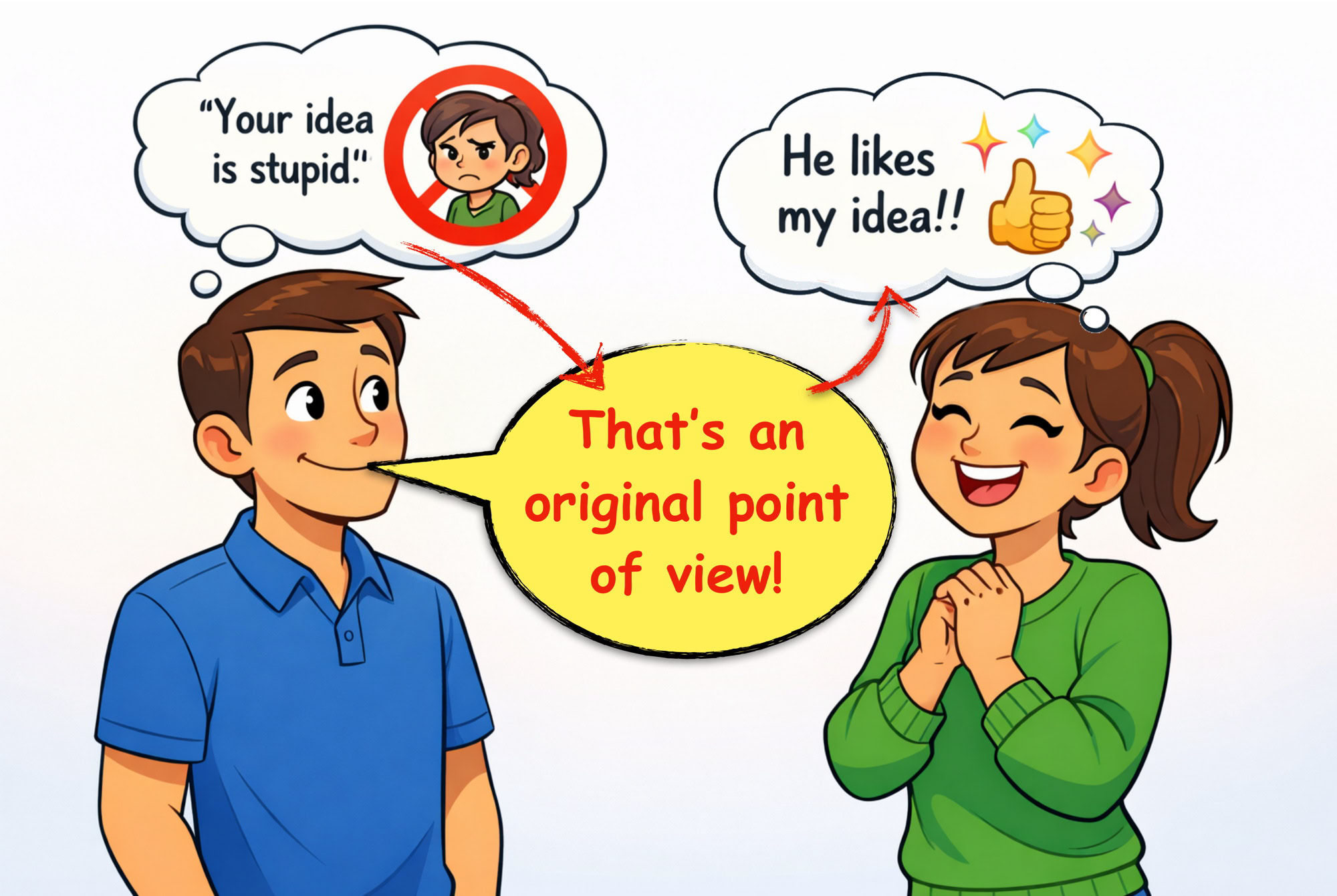
It doesn’t require a mumbled sentence for misunderstandings to arise in a meeting. Even when everyone shares the same first language, misunderstandings arise because the same word may be used differently by different people.
For example, a study by YouGov in 2018 documented what anyone who has worked in international environments knows well: people in the UK and the US have quite different understandings of words that express positive and negative opinions. YouGov tested 40 words that ranged from “abysmal” at the negative end of the spectrum to “perfect” at the positive end, and found that people in the US tend to be somewhat more hyperbolic when expressing positive opinions.
As shown in the diagram below from the YouGov study, American speakers tend to use a narrower range of words that tends towards greater positivity when they describe situations for which British speakers would usually use a wider range of more measured words.

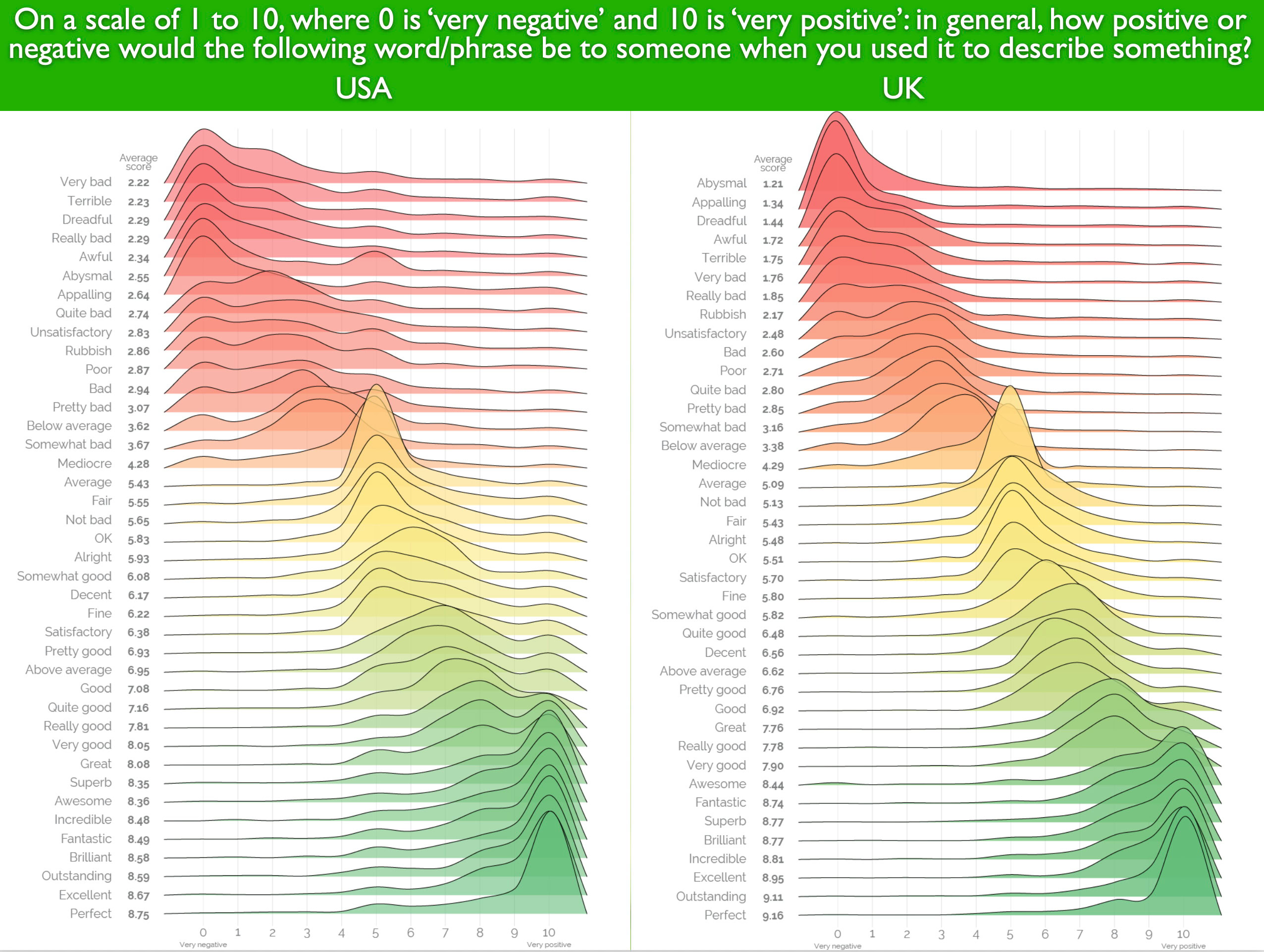
This finding seems to suggest that former British prime Minister, Winston Churchill, was right when he asserted “England and America are two great nations separated by a common language”. It also helps to explain the stronger trend towards grade inflation through the award of high marks with glowing feedback in US schools compared with schools elsewhere.
However, misunderstandings are not restricted to the alleged gap between American hubris and English diffidence. In numerous articles, Nanette Ripmeester compares the use of language by British and Dutch speakers of English. She notes that British speakers make extensive use of paradoxical meanings that may cause confusion for people from different cultures such as the Dutch, whom she characterises as being “renowned for their directness”. She offers the following comparative tables to illustrate the challenges which arise in both social and professional settings:
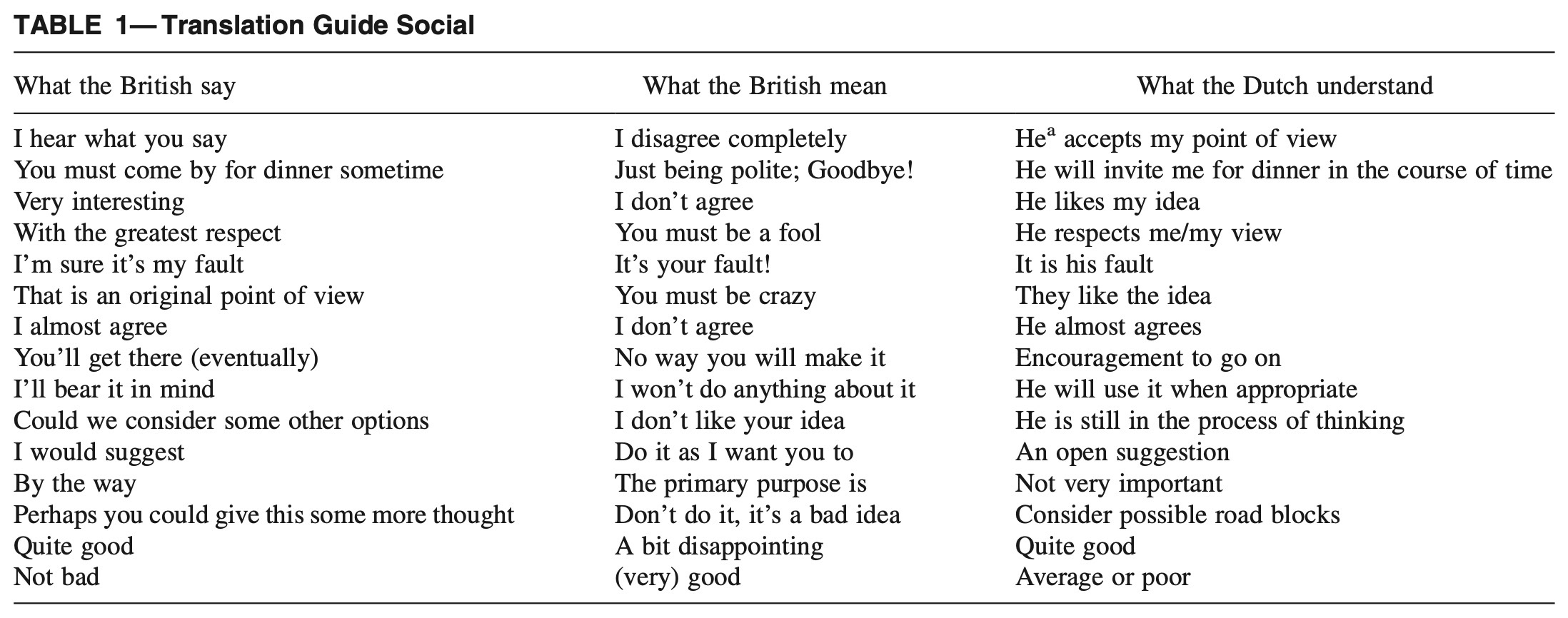
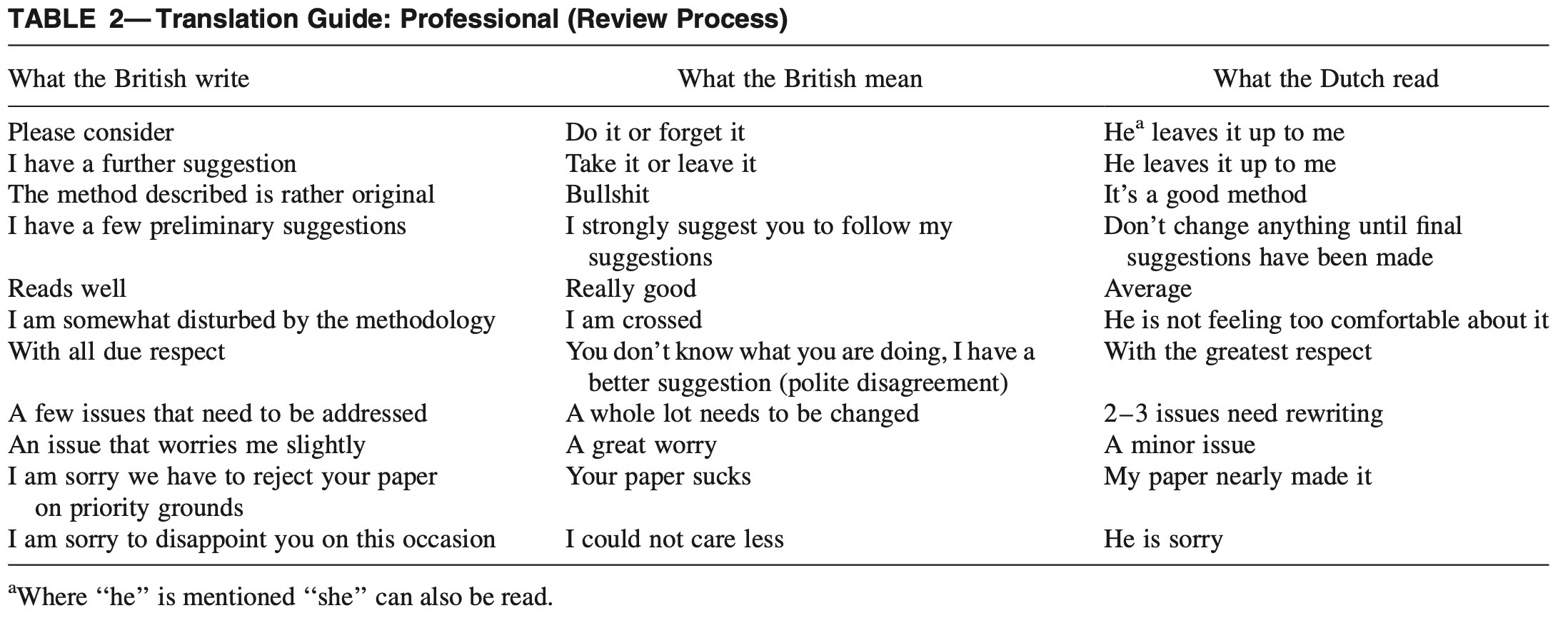
There is a technical name for such situations: it is the problem of semantic drift and equivocation in deliberative settings. It can present significant but often unrecognised problems in schools during staff meetings, departmental discussions and even board meetings. The problem arises when participants operate with different mental models while (wrongly) assuming shared meaning. In school board governance, semantic drift and equivocation is especially risky because ambiguity at the decision stage can easily become conflict at the implementation stage.
There are five interventions that a wise, astute Board Chair can use to eliminate ambiguity and ensure semantic alignment.
1. Define key terms before discussions begin.
When a term is central to the agenda item (for example, strategy, risk appetite, oversight, performance, sustainability), the Chair should ensure that all board members understand the definition in operational terms before the discussion proceeds.
For example, rather than beginning a discussion with “Let’s discuss whether this aligns with our strategy”, it would be better to say something like “Before we proceed, how are we defining ‘strategy’ in this context; is it our five-year growth plan, our capital allocation priorities, or our mission alignment?”
Explicitly defining terminology in operational terms enables the conversation to shift from abstract language that some attendees might not understand into words that have immediate relevant meaning. Ideally, these definitions are explicit, recorded in the minutes, and referenced frequently during the discussion, thus increasing the likelihood that attendees will be discussing the same concepts in the same contexts as one another.
2. Use “meaning checks” during the discussion.
When ambiguities arise, the Chair should pause and test understanding. A good way to do this is to ask attendees to mirror back to someone in their own words what they think that person was saying. For example, someone might ask “when you say ‘accountability,’ are you referring to reporting lines or performance consequences?”. Another example of a “meaning check” would be “is everyone using ‘governance’ here to mean strategic oversight rather than operational management?”. To some attendees, this may sound like pedantry, but for others, it is really helpful disciplined facilitation. A Board Chair who routinely clarifies meaning to ensure everyone is ‘on the same page’ is not showing weakness, but governance strength.
3. Require proposals to be framed in concrete language.
Ambiguity often hides in aspirational phrasing. Therefore, instead of allowing a simplistic, unsubstantiated assertion such as “We should strengthen oversight” to go untested in a meeting, the Chair should ask for concrete clarifications such as “what specific behaviours would change if we adopt this?”, or “what would be measurably different in six months?”. Forcing speakers to replace vague aspirations with precise observable outcomes replaces ambiguity with actionable meaning.
4. Summarise and paraphrase before moving to resolution.
Before proceeding to a vote or declaring a consensus, it is helpful if the Chair synthesises the preceding discussion along the lines of “let me summarise what I believe we are agreeing to…”. The Chair would then proceed to state the proposed resolution, and if appropriate, outline the scope, any limitations, consequent responsibilities and actions, and the proposed timeline. If a board member then responds, “that’s not quite what I meant,” the ambiguity surfaces before the decision is formalised and can be clarified accordingly. This technique, which is often referred to as reflective synthesis, prevents semantic misunderstandings from degenerating into governance conflict.
5. Institutionalise a board glossary or list of definitions
For terminology that arises repeatedly in discussions, it may be helpful to develop a glossary of key terms as part of the Board Manual or Board Charter. This document would contain clear definitions of foundational terms such as governance vs management; oversight vs execution; risk monitoring vs risk ownership, and so on. This is especially valuable for boards with members from different professional backgrounds (legal, financial, educational, community, etc), and where discipline-specific jargon may contaminate or obscure shared vocabulary. Over time, the glossary should create a common lexicon that reduces the risk of hidden variations in interpretation.
– Dr Stephen Codrington
A detailed study of effective communication in schools can be found in the article Communicate to Persuade. This is supported by a meeting-focussed discussion of language in schools in Language and Communication in Board meetings, supplemented by two articles on the importance of using language precisely in schools: Language Matters and Euphemisms and jargon are enemies of effective school leadership.
We offer support for school leaders and board members in many areas, including workshops on communication in schools.
Further information on this and many other facets of best practice in school leadership and governance is provided in the books “Optimal School Governance", and “DARING INSIGHTS into School Leadership and Board Governance”, which can be ordered directly through Pronins.
You may also be interested in previous articles which are archived at https://optimalschool.com/articles.html. You can subscribe to receive future articles by e-mail using the red button below.