

Having observed hundreds of school boards over the years, I feel I am well equipped to make this statement: Many school boards function under the delusion that are operating effectively.
That statement should shock and disappoint anyone who believes that good education is the key to our collective future. It should shock and disappoint anyone who has blind confidence that the school they send their children to is truly focussed on educational excellence. It should shock and disappoint anyone who thinks all schools use their finances wisely and judiciously. And yet, I fear many people will simply shrug their shoulders and say “tell me something I don’t already know”.
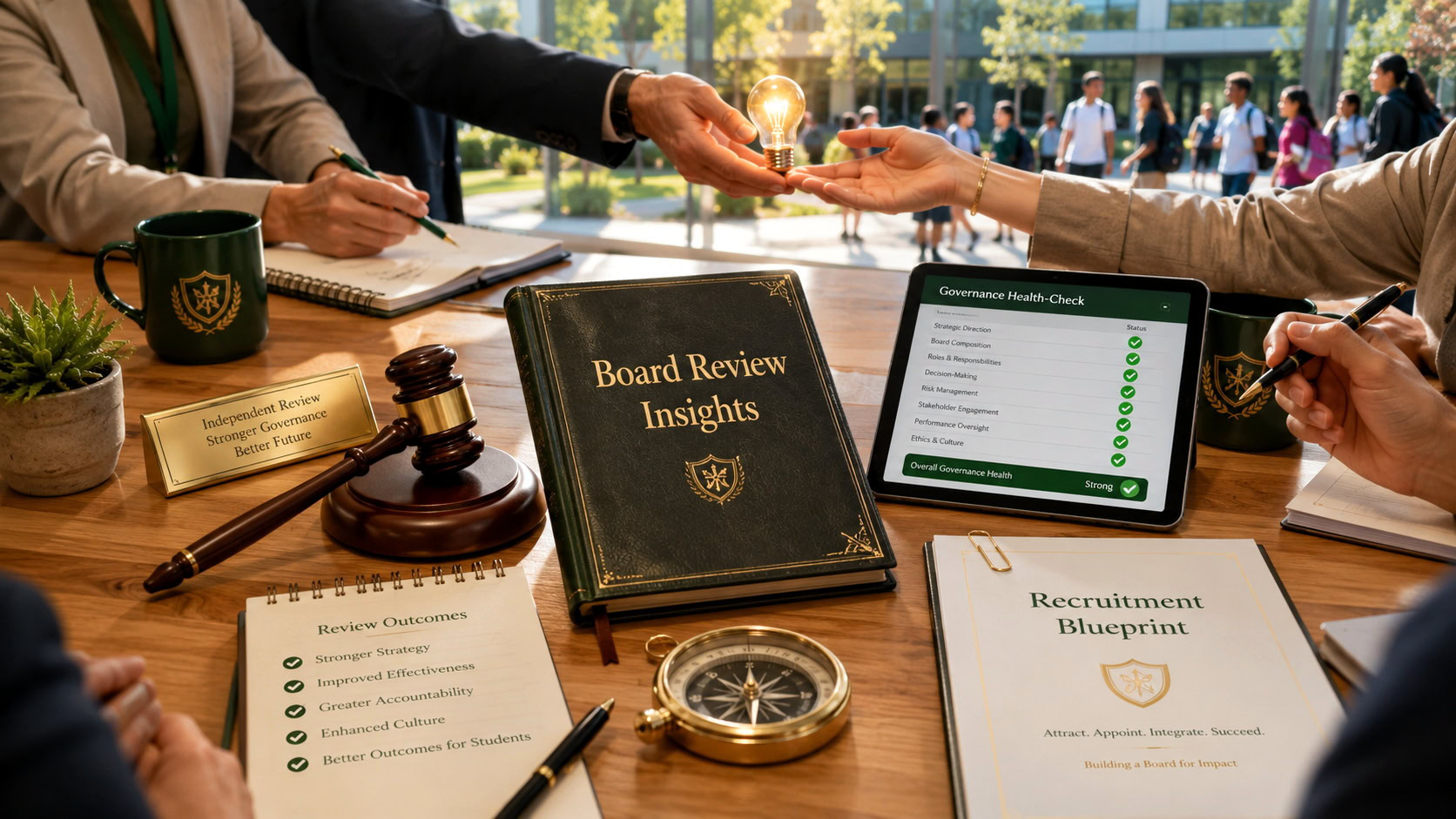
The simple, yet shocking and disappointing reason that many school boards remain unaware of their shortcomings is that they never undertake regular, independent, external reviews of their performance. Of course boards expect their Principal to evaluate staff annually. They even undertake their own annual reviews of the Principal. And yet many board members refuse to subject themselves to the same quality standard.
Some real quotes I have heard from Board Chairs over the years give an insight into the misguided complacency that characterises too many school boards:
The first quote is nothing more than an assertion of arrogance. Boards with long-standing members who have never sought external advice on procedures and performance almost invariably settle into comfortable practices that remain unchallenged, thus perpetuating bad practice through simple inertia. Moreover, even if the board was implementing the world’s best, most perfect practice twenty years ago and had never deviated since, legal and societal changes since that time mean the board would now be seriously out-of-step with contemporary expectations and requirements. School boards must remain in-step with the changing demands of governments, parents, accreditation agencies, teachers, the wider community – it’s a long, very substantial list.
The second quote may sound noble at first, but it is really just a poor excuse for not wanting to engage in a review. Board reviews are typically inexpensive to conduct, they take little time (except perhaps for the external consultant conducting the review), and in reality, they add value to the school by pointing out the potential for new efficiencies in board procedures and priorities. Board reviews represent a non-threatening quality enhancement mechanism because they are conducted by someone who is independent and separate from the school with no ‘skin in the game’ and therefore no fear of eroding ongoing political capital.
The third quote is an attempt to justify mediocrity on the basis that board members are generously giving up their time. Although it is reasonable for a school board not to demand the onerous amount of time required by large, corporate boards, the same high standards of governance should definitely be expected from members of school boards. After all, members of school boards carry the ultimate consequences for everything that happens in their school. Therefore, exemplary standards should be expected from every board members in the areas of professionalism, attention to legal and fiduciary duties, strategic vision and passion for the enterprise.
The fourth quote is actually counterintuitive. A period of transition in board membership is a sound reason to do a review, not a reason to postpone it. A review provides the board with an opportunity to revisit its operating structure, to help orient new members, to refocus its priorities and to correct any long-established ‘bad habits’ before they become adopted by default by new, incoming board members.
The fifth quote is akin to waving a white flag of surrender in the battle to recruit energetic, curious board members who will contribute actively and hold themselves to high standards. A well-structured board performance review may well unlock the barrier that is making recruiting the ‘right’ new board members so difficult, and thus should be seen as a ‘feature’, not a ‘bug’, of sound board practice.
It is too easy for school boards to mutter the feeble excuse that “now is not a good time for a board review.” The problem is that no time seems to be a good time for some boards, and the longer the procrastination continues, the greater will be the inertia that must be overcome to achieve genuine improvement for the school.
- Dr Stephen Codrington
We offer support for school leaders and board members in many areas, including conducting board performance reviews.
Further information on this and many other facets of best practice in school leadership and governance is provided in the books “Optimal School Governance", and “DARING INSIGHTS into School Leadership and Board Governance”, which can be ordered directly through Pronins.
You may also be interested in previous articles which are archived at https://optimalschool.com/articles.html. You can subscribe to receive future articles by e-mail using the red button below.