
During his long career, the American author John Carver wrote extensively about board governance. He summed up the essence of governance very succinctly in these words: “Governance exists in order to translate the wishes of an organisation’s owners into organisational performance”.
The owner and the board govern the school, but the Principal and the senior management manage the school. The owner, the board, the Principal and the senior management together comprise the school’s leadership team. This does not mean that their roles are interchangeable. Serious problems arise if those in governance stray into management, just as serious problems arise if those in management try to govern the school.
Like any team, all the members of a school’s leadership team must respect each others’ roles, demonstrate mutual support and play to each other’s various strengths. The Principal has a right to expect that the school board will work to recognise and resolve the challenges of governance, and the board has a right to expect that the Principal it has appointed will address the organisational issues and challenges of management without intruding into the job of governance. Each element of the leadership team should expect every other element to perform their role effectively while “staying in their lane”.
Effective adherence to the Governance-Management Authority Cycle is thus foundational to effective school leadership. The way in which this should work is shown in the diagram below.
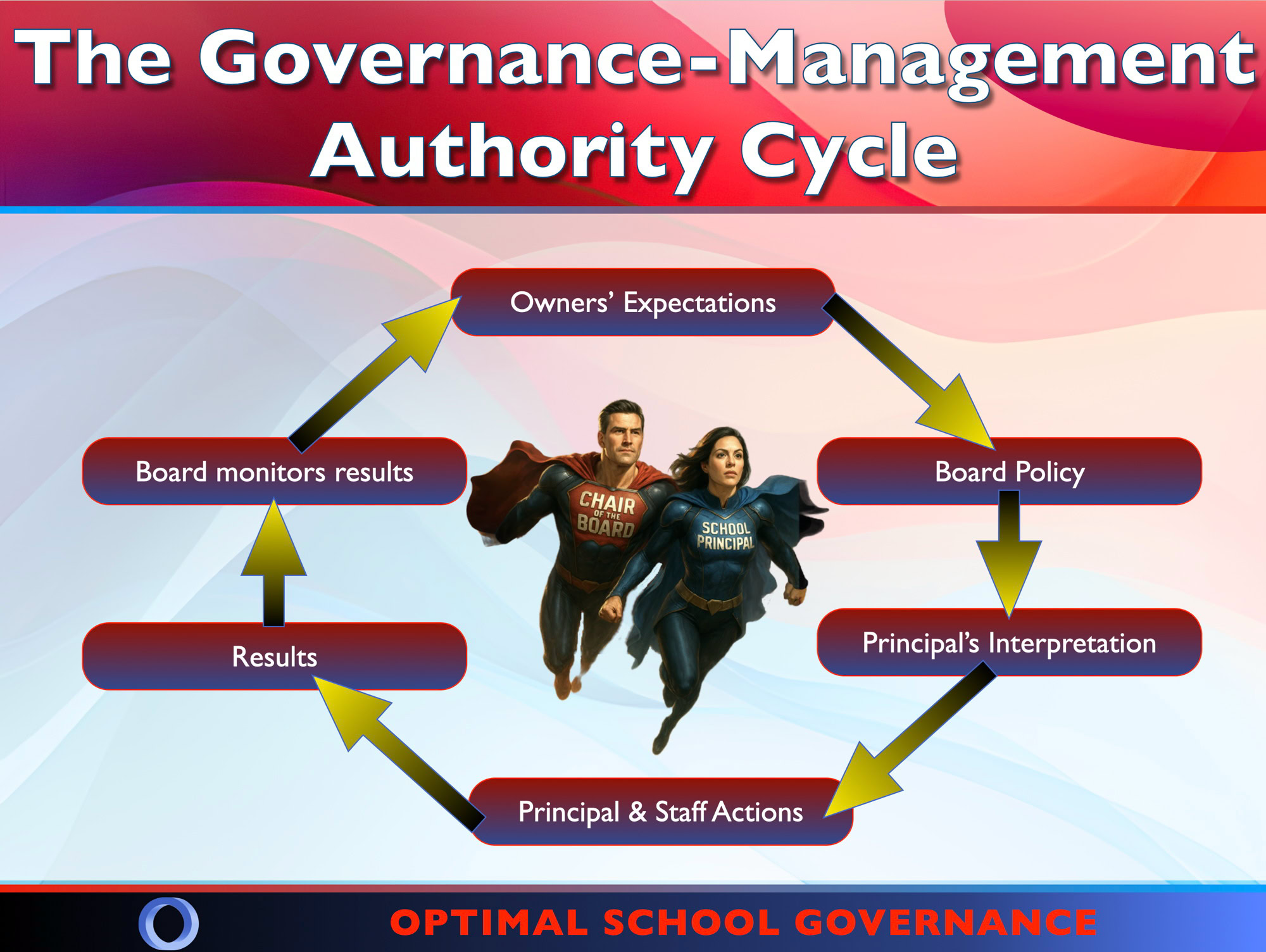
Boards exist to translate the owner’s wishes into wise, discerning, effective action. The board does this by articulating the owner’s mission, defining the strategic vision to implement that mission, and then developing policies and delegating the authority to implement these policies to the Principal as CEO of the organisation. The Principal interprets these policies and directives, delegates implementation of many of them to the staff for implementation while also working to achieve those tasks which cannot be delegated.
The actions of the Principal and the staff collectively achieve results, most of which are hopefully positive and intended, although some will inevitably fall short of expectations and aspirations. All these results, good and bad, are reported regularly to the board by the Principal so that the board can monitor the effectiveness of its policies (and also the Principal in putting them into everyday practice). The board then communicates the outcomes achieved to the owner, who in turn refines future expectations which are communicated to the board – and so the cycle continues once again. At no point does the board (or the owner) become involved in day-to-day management or operations of the school.
For the Governance-Management Authority Cycle to function effectively, it is essential to build a firm foundation of mutual trust. Such trust depends upon every person within the Cycle faithfully and generously fulfilling every expectation of their role to ensure a “no surprises” environment.
The board has every right to expect its Principal to be honest, transparent and to produce positive results. A wise board will understand when certain goals prove beyond the reach of the Principal to deliver, and will often respond by discussing ways it can offer more support, such as providing additional resources. Having said that, no board should ever tolerate a lack of integrity on the part of its Principal.
In turn, the Principal has a right to expect the board to state its expectations clearly and then adhere to its commitments. The Principal should also expect the board to speak with one voice and avoid bringing the Principal into internal disputes among board members.
Both the board and the Principal have the right to expect absolute loyalty in public from the other. Both board and Principal also have the right to expect that all the other participants in the Governance-Management Authority Cycle will perform their duties fully, honestly and professionally.
Of course, no model can guarantee that a board or its Principal will always make wise or appropriate decisions. There is no law and there can be no foolproof protection against school leaders making foolish or simply bad decisions. However, the clearly defined roles and the implicit checks and balances within the Governance-Management Authority Cycle offer schools a high probability of successful and effective leadership – provided the model is applied faithfully by every participant.
- Dr Stephen Codrington
We offer support for school leaders and board members in many areas, including workshops and direct support on the relationship between governance and management in schools.
Further information on this and many other facets of best practice in school leadership and governance is provided in the books “Optimal School Governance", and “DARING INSIGHTS into School Leadership and Board Governance”, which can be ordered directly through Pronins.
You may also be interested in previous articles which are archived at https://optimalschool.com/articles.html. You can subscribe to receive future articles by e-mail using the red button below.