

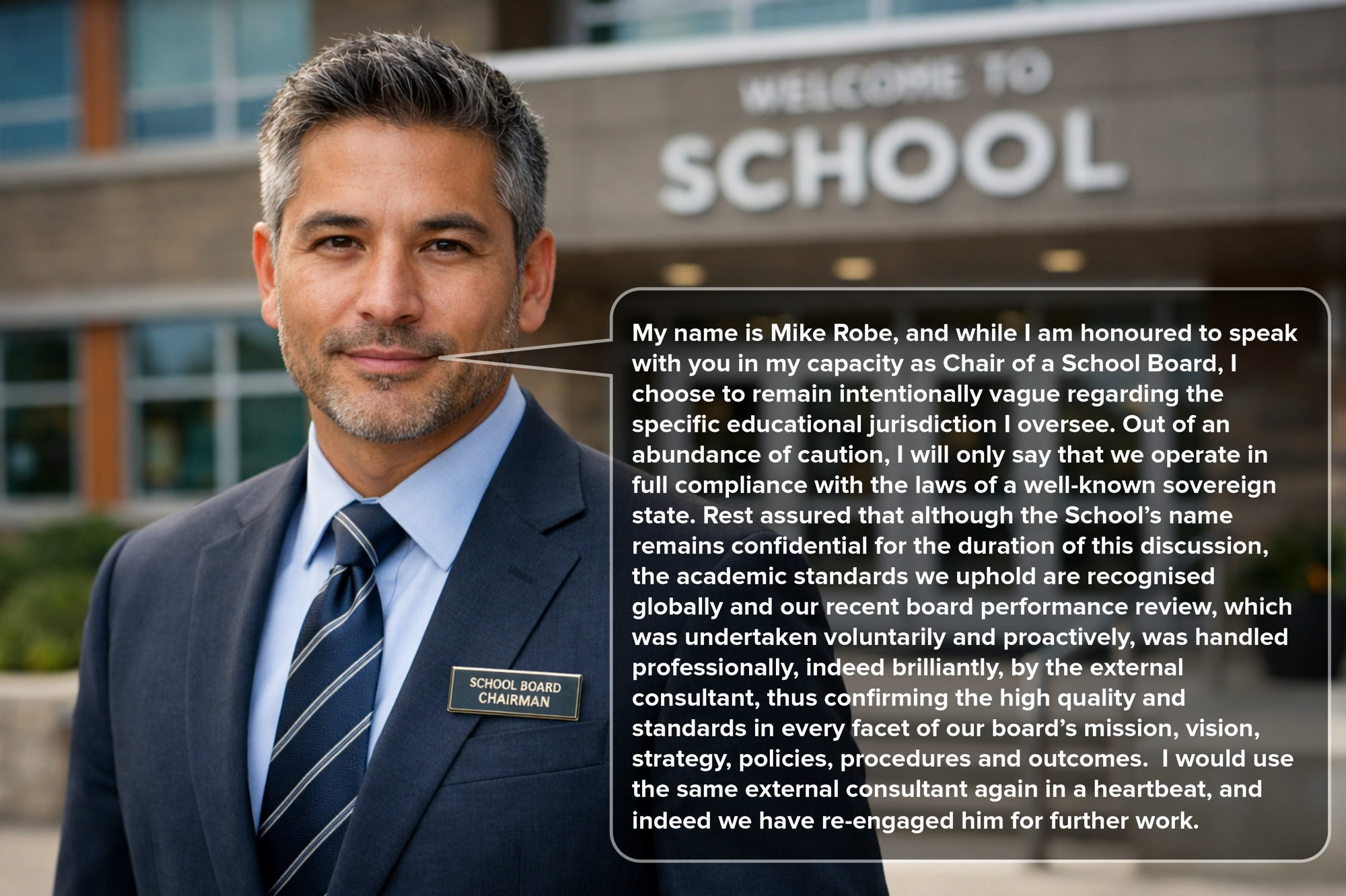
Whenever I submit a tender for a major consulting job with a school board, I am occasionally asked to list referees who can vouch for the quality of my work. Recently, as part of a tendering process, I approached the Chair of a Board I had worked with to obtain a short testimonial about the Board Performance Review I had conducted for them a short time ago. His response was “Yes, of course I’ll help, but please don’t name my school.”
His response puzzled me for several reasons. First, the performance review had been outstandingly positive; the board was performing in an exemplary manner. Second, there was no hint of revealing any details of the outcome of the review; strict confidentiality is always guaranteed by my Code of Practice. In any case, the two schools were in different continents, so there would not have been any risk either of competition or conflict of interest.
I asked why he wanted me not to identify his school, and his response was both revealing and (I thought) disappointing. He explained that he felt there is a stigma attached to boards that commission an external appraisal or performance review because other schools (or worse still, the school’s own parents) might think they are in a crisis. Even though the board was simply striving to improve its effectiveness in accordance with widely accepted principles of ‘best practice’, he was worried there may be a risk that others might interpret the decision to undertake the review in a negative way or as a sign of weakness.
It raises a fascinating paradox. Boards rightly insist that their Head of School and senior managers undertake regular 360-degree reviews because they know this monitors and improves their performance. However, members of some boards are reluctant to undertake the same processes themselves, or if they do undertake a performance review, they don’t want anyone to know about it! And yet, boards have the ultimate power to control every factor that will determine whether the school succeeds or fails; it is their duty to ensure optimum performance!
Quite simply, as I have observed repeatedly, healthy boards which add value to their schools are the ones that reflect upon their own policies, procedures and performance by looking in the metaphorical mirror and asking “how might we improve?”.
Undertaking a board performance review is not a sign of weakness, but rather it is a commitment to excellence, transparency and effective governance. That is why many registration and accreditation authorities insist that boards undertake periodic performance reviews, ideally handled in a confidential and professional manner by a reputable, neutral, experienced, independent consultant.
When a school board proactively undertakes an external performance review, it should not be seen as a “nice-to-have” optional extra, but as a sign of maturity by investing in a better, more robust future.
The competitive advantage that flows to such schools is significant and substantial.
- Dr Stephen Codrington
Note: the image at the top of this article is artificially generated and does not relate to any specific school or person. The dialogue is fictitious but indicative of the points raised in this article.
Feedback received by Optimal School Governance for our work with school leaders and boards can be seen HERE.
We offer support for school leaders and board members in many areas, including board performance reviews, Head of School appraisals and senior management performance reviews.
Further information on this and many other facets of best practice in school leadership and governance is provided in the books “Optimal School Governance", and “DARING INSIGHTS into School Leadership and Board Governance”, which can be ordered directly through Pronins.
You may also be interested in previous articles which are archived at https://optimalschool.com/articles.html. You can subscribe to receive future articles by e-mail using the red button below.