

In any independent or international school, visionary leadership by the Board is necessary for sound governance, but it is never sufficient. Sound governance can only be sustained by ensuring that foundational principles of trust and precision also inform the board’s processes. Two often-neglected roles sit quietly at the centre of these foundational processes: the Board Secretary and the Company Secretary.
While their titles are sometimes used interchangeably in casual conversation, their responsibilities, accountabilities, and relationships with key leaders are quite distinct. Understanding these differences is essential for any board that seeks to operate with clarity, legality, and strategic confidence.
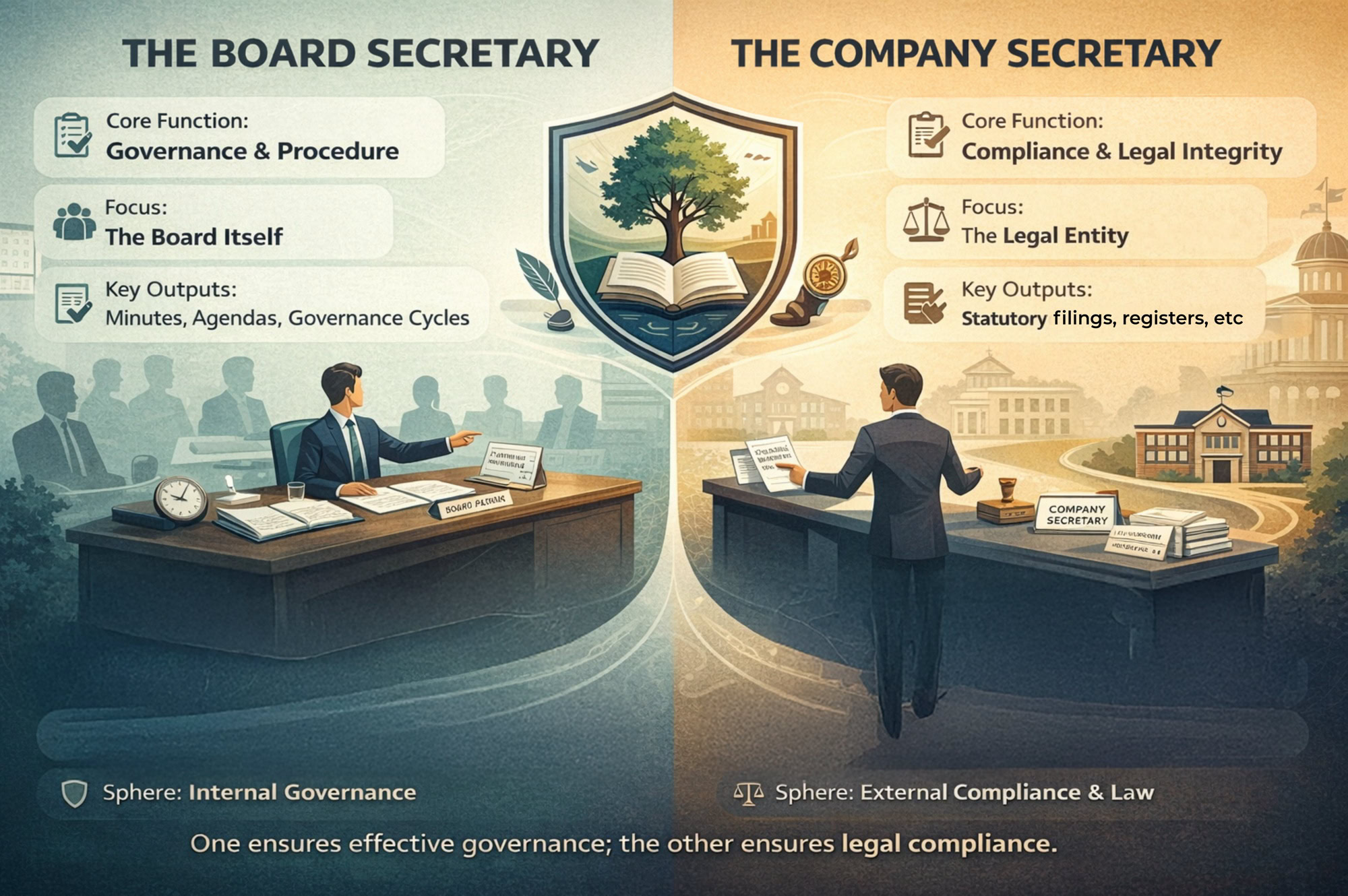
The Board Secretary is fundamentally the guardian of the board’s effectiveness as a governing body. Their primary responsibility is to ensure that the board functions smoothly, ethically, and in accordance with its own policies and terms of reference. This role is deeply embedded in the rhythm of board work: preparing agendas in consultation with the Board Chair, circulating papers in a timely manner, recording accurate and impartial minutes, tracking decisions, and monitoring follow-up actions. The Board Secretary is also the custodian of governance memory, maintaining records of resolutions, policies, committee terms-of-reference, and board evaluations. In schools with boards that are characterised by cultural diversity, rotating membership, and complex accreditation environments, this continuity is invaluable for institutional memory.
The relationship between the Board Secretary and the Board Chair is close, professional, and built on mutual trust. The Chair relies on the Board Secretary as a procedural adviser and organisational anchor. While the Chair sets the tone, priorities, and leadership of the board, the Board Secretary ensures that these intentions are translated into compliant processes and well-run meetings. A skilled Board Secretary will discreetly advise the Chair on governance norms, conflicts of interest, quorum requirements, and decision-making protocols, thereby protecting both the Chair and the board from mis-steps that could undermine credibility or legitimacy.
The Board Secretary’s relationship with the Head of School is by necessity collaborative but carefully defined. The Head of School is typically responsible for preparing substantive reports and proposals for board consideration, and the Board Secretary facilitates this flow of information without becoming an operational intermediary. Importantly, the Board Secretary does not manage the Head of School, nor do they advocate for management positions. Instead, Board Secretaries support a healthy governance–management relationship by ensuring communication is structured, transparent, and aligned with agreed roles. In well-governed schools, the Board Secretary helps preserve the board’s strategic focus by preventing drift into operational detail.
By contrast, the Company Secretary occupies a role grounded in corporate law, regulatory compliance, and fiduciary accountability. Whereas the Board Secretary serves the governance process, the Company Secretary serves the legal entity itself. This role is responsible for ensuring that the school, as a company or incorporated body, meets all statutory obligations: filings with regulators, maintenance of company registers, maintenance of conflict of interest and related party transaction registers, compliance with constitutional documents, and adherence to region-specific governance requirements. In short, the Company Secretary performs a critical risk-management function.
The Company Secretary’s relationship with the Board Chair is more formal and compliance-oriented than the relationship with the Board Secretary. The Chair depends on the Company Secretary for assurance that decisions are legally valid, that delegations of authority are properly recorded, and that the board’s actions align with the organisation’s constitutional framework. While the Board Secretary may focus on how well the board is governing, the Company Secretary focuses on whether the board is operating within the law. In moments of organisational stress, such as periods with major capital projects or regulatory scrutiny, the Company Secretary becomes a key adviser to the Chair, often operating behind the scenes to safeguard the institution.
The relationship between the Company Secretary and the Head of School is typically indirect but strategically significant. The Head of School may rely on the Company Secretary for guidance on matters such as signing authority, contractual obligations, or regulatory implications of operational decisions. However, the Company Secretary does not sit within the management hierarchy and does not take instructions from the Head of School in matters that could compromise legal independence. Instead, the Company Secretary acts as a stabilising presence, ensuring that any enthusiasm for innovation or growth is matched by due diligence and legal prudence.
These structures all seem clear, and yet the roles of Board Secretary and Company Secretary seem far more confused in many schools. The consequences are like be some combination of inefficiency, chaos, dysfunction, non-compliance and illegality.
Some simple questions and answers may be helpful for schools trying to define these roles:
In high-performing, well-governed schools, the roles of Board Secretary and Company Secretary should not duplicate or overlap, but function separately with well-defined clarity and strength in harmony with each other. One role (Board Secretary) protects the quality of governance; the other (Company Secretary) protects the integrity of the organisation. Their respective relationships with the Board Chair and Head of School form a quadrilateral of accountability that ensures trust, clarity, and sustainability. When these roles are clearly defined and professionally executed, the board can lead with confidence, the Head of School can operate with security, and the school community can benefit from governance that is principled, precise and comprehensive.
- Dr Stephen Codrington
We offer support for school leaders and board members (including Board Chairs) in many ways, including through workshops for boards and school leaders on Board operations and the Board’s duties.
Further information on this and many other facets of best practice in school leadership and governance is provided in the books “Optimal School Governance", and “DARING INSIGHTS into School Leadership and Board Governance”, which can be ordered directly through Pronins.
You may also be interested in previous articles which are archived at https://optimalschool.com/articles.html. You can subscribe to receive future articles by e-mail using the red button below.