

Once upon a time, schools used to be able to control their narrative. Principals wrote carefully worded editorials in the Newsletter, they wrote occasional articles in professional journals, they sent ‘Letters to the Editor’ in the hope they would be published in reputable newspapers, and they spoke at meetings of community and local sporting organisations. Principals joined Rotary Clubs, local Chambers of Commerce, business groups and sometimes even political groups. Some larger schools even engaged public relations officers to ensure the school’s messaging would be polished in ways that might enhance the school’s reputation.
Of course, no school has ever been fully in control of its public reputation. I have often thought that the most powerful type of marketing for any school are the conversations that occur between parents at children’s birthday parties, or standing beside the sports field watching their children play a match, or even when standing in the car park or at the bus stop waiting to collect their children after school. And when I say that these conversations can be powerful, I mean for their potential negative as well as positive impact.
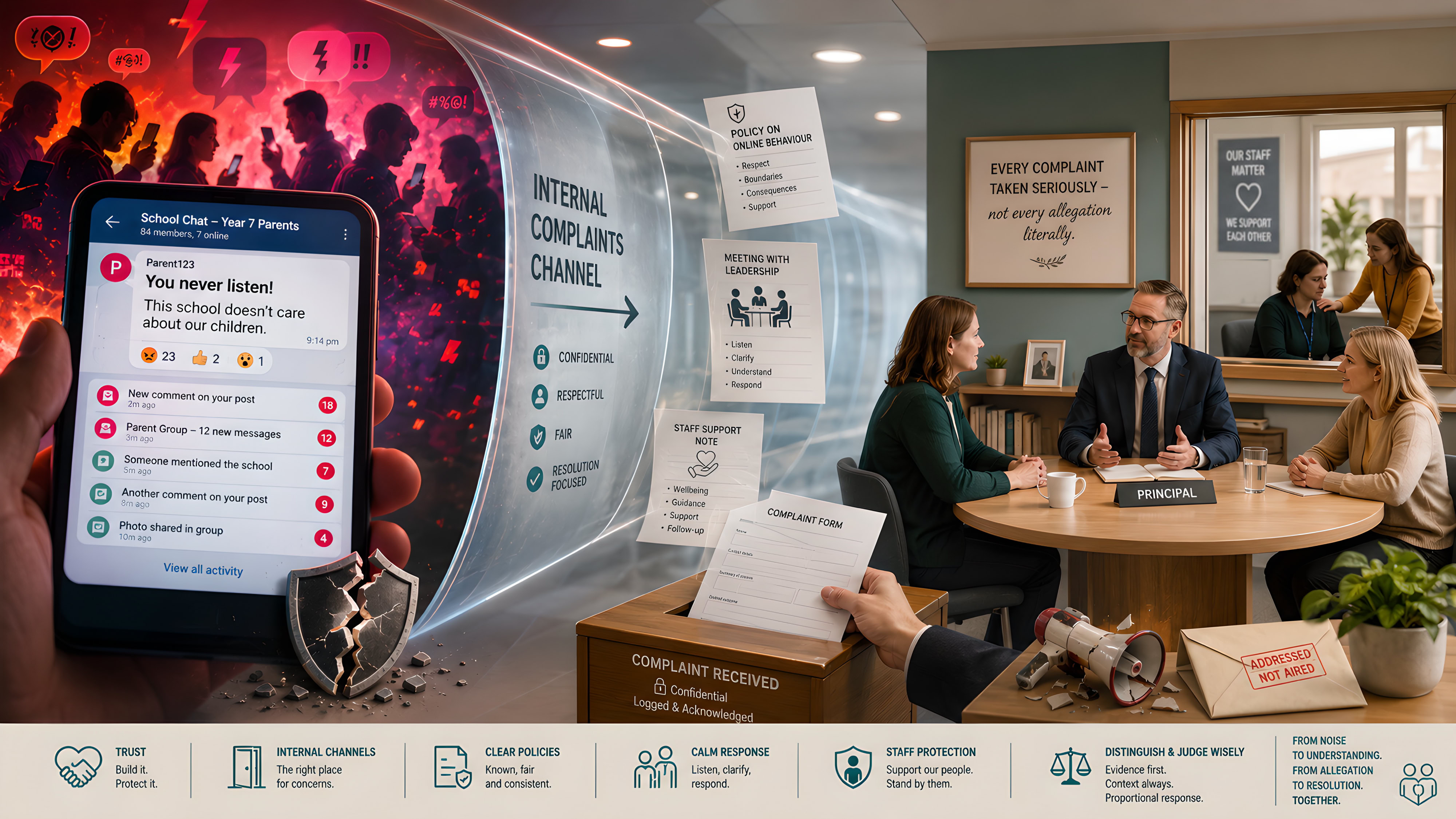
With the widespread advent of mobile phones, discussions about schools among parents and in the wider community have become far more democratised, or to express this from the school’s perspective, far less able to be controlled. The risk of uncontrolled reputational damage to schools can be extreme, especially during periods of internal instability, when a popular staff member is leaving, when an influential parent’s child has been suspended or expelled, or indeed, in any real or imagined crisis.
I have heard it said that schools should be grateful when parents complain, even when they do so publicly online, because it shows they care about the school. The argument being made is that upset parents who don’t care about the school simply withdraw their children and say nothing. On the other hand, making a public complaint is akin to a desperate plea for improvement.
Personally, I suspect that the tone of many online complains indicates contempt rather than care, but it is difficult to generalise, and even more difficult to drill into another person’s motivation. I certainly do feel, however, that any complaint is far more likely to be addressed if it is brought personally to the attention of the Principal (or to the Board Chair if the complaint is about the Principal) behind closed doors rather than announcing it to the world through online chat sessions or an online petition.
A significant problem with online complaints is that they can take on a life of their own that spirals out of control in a manner that becomes increasingly distant from the original concern. In my consulting work in various parts of the world, I have seen a WhatsApp discussion lead to widespread student withdrawals within three days, I have seen an online petition lead to the mass resignation of all but two members of a 16-member board, I have seen a Facebook discussion lead a school to cancel a program for special needs children on the grounds that spending money on catering for a ‘minority’ of students meant the ‘majority’ was being neglected, and so on. Angry parents don’t need a car park to spread gossip when they all have basic keyboard skills and a mobile phone in their hand.
The real issue with online complaints the speed with which they spread. A long while before the internet was invented, Jonathan Swift wrote in 1710 that “A lie can travel halfway around the world while the truth is still putting on its shoes”. An MIT study in 2018 showed that on Twitter (now X), false news travels six times faster than true stories. Interestingly, it found that the spread of false information is essentially not due to bots that are programmed algorithmically to disseminate inaccurate stories, but rather that false news spreads faster due to people retweeting inaccurate news items. The researchers found that false rumours inspired replies expressing greater surprise because of their novelty, and thus capacity to generate greater fear and disgust. On the other hand, as explained in this article, the truth inspired greater sadness, anticipation, joy, and trust, all of which were less sensational and therefore less interesting to share with other people.
And yet, no school should be above honest criticism if improvements are needed to enhance their identity and improve their educational performance – in other words, enhance the mission, vision, purpose, philosophy and strategic outcomes.
An emerging, related facet of online complaints should be acknowledged, and that is the increasing use of AI. I am aware of many schools that are now receiving formal complaints that have been generated by parents using AI. These complaints are frequently in excess of 50 pages, a far cry from the traditional one-page letter or the 10-minute phone call. Given the excessive detail and legalistic references that are often features of AI-generated complaints, many schools feel they need to engage expensive legal advice to ensure the complaint is handled in a manner that avoids (or minimises) litigation. At the risk of seeming overly simplistic and quaintly naïve, my advice to Boards and Principals who receive AI-generated complaints is to pick up the phone and speak to the parents. Under no circumstances should the school get into an AI-generated, point-by-point, back-and-forth debate.
In essence complaints should not be seen as a simple communications problem or ‘optics challenge’, but as a complex governance, trust, and conflict-management issue. In that context, how should school leaders and boards handle the growing challenge of online complaints?
1. Prepare by investing in relational trust with parents
Research in education clearly shows that schools with high levels of relational trust experience fewer destructive conflicts. Complaints still occur of course, but families are less likely to assume bad intent or seek public escalation in environments where trust has been established.
Schools can help to build trust by taking the initiative to explain school decisions transparently (especially on matters such as discipline, wellbeing and safety), communicating frequently and honestly when problems arise, scheduling consultative meetings, and ensuring both senior and middle management are visible and accessible,
2. Establish low-friction internal complaints pathways
Schools can help to build trust by publishing very clear “How to Raise a Concern” pathways, responding quickly to concerns (certainly within 24 to 48 hours), training middle management to resolve low-level concerns before they escalate, and distinguishing between concerns, complaints and serious grievances to minimise the likelihood that minor issues will grow into formal disputes.
Parents usually resort to posting online because they feel their concerns have not been heard or taken seriously. Indeed, research into complaint systems shows that procedural fairness (being heard, treated respectfully, and informed of processes) often matters as much as the substantive outcome.
Concerned parents are much more likely to express their discontent publicly when they feel frustrated because they believe their complaints are being ignored. Schools that can resolve concerns early and informally tend to experience less escalation into public forums. At the risk of stating the obvious, early intervention, procedural clarity, and transparent responsiveness are strong preventive measures against public criticism.
3. Develop and promulgate clear expectations of civility
Schools benefit from setting clear expectations for online conduct before conflict arises. This can take the form of a policy which has been circulated, but it is more powerful if it is in the form of an agreement that is signed by parents as a commitment when they enrol their children in the school. Schools that explicitly communicate expectations around respectful digital behaviour report fewer misunderstandings and more effective responses if escalation occurs.
Effective agreements usually cover social media and messaging groups, setting clear boundaries around harassment, defamation, bullying and intimidation, with a request not to identify staff or students publicly in complaints, and to follow the principle of “raise concerns with the school first”.
It is important that schools avoid trying to “ban criticism”. Heavy-handed legalistic approaches often backfire and can create a perception of institutional defensiveness. The expectation should be constructive disagreement within a respectful process.
4. Respond quickly and calmly, but don’t argue publicly online
Public rebuttals rarely de-escalate conflict, especially in emotionally charged parent networks. Indeed, public exchanges can legitimise rumours, trigger further attacks, breach confidentiality, and potentially expose the school to legal claims. Schools should never enter into a point-by-point public rebuttal of an online attack as it gives oxygen to the discontent and will almost certainly never convince the people who posted the online criticism. Similarly, the school should resist calls during a ‘crisis’ for a large, public “town hall” meeting as this will give critics a metaphorical megaphone to air their grievances in front of a large, persuadable audience.
When complaints appear online, the school should first assess the risk. Does the issue focus on student safety, or reputation, or staff harassment, or misinformation, or something else? Having done this, the Principal should contact the complainant privately if possible and quickly move the discussion offline. Correspondence and discussions should use professional language, be neutral in tone, and non-accusatory.
It is important to avoid impetuous or rushed emotional rebuttals, naming staff or students, posting confidential details in an attempt to defend the school, or trying to “win” online. The aim of responding to online complaints is not to win an argument but to reduce amplification and widespread dispersal of anger, thus redirecting the matter into a proper resolution process consistent with the school’s Complaints Policy.
5. Protect staff while still taking the complaint seriously
When schools in crisis (but before they ask for my help), I have found that they sometimes fall into either one of two ‘opposite’ extremes. Some schools reflexively defend their staff regardless of the evidence, while others reflexively sacrifice staff to placate the complainants. Neither reaction usually works well.
Teachers who have been loyal to the school naturally expect loyalty from the school’s leadership when accusations against them surface. Teachers who feel unsupported by the school’s leadership inevitably experience burnout, reduced morale, and defensive professional practice.
Schools must therefore conduct any investigation using a fair, evidence-based process. To achieve this, the school must investigate facts before reacting, and ensure staff are kept informed and supported during investigations. The school has a duty to discern vexatious, malicious or emotional complaints from those which may be legitimate, and to demonstrate support to staff if and when it is clear that they have followed policies and procedures appropriately.
A useful principle for both boards and principals is “take every complaint seriously, but not every allegation literally”.
6. The Board’s role
Boards have a duty to monitor several facets of complaints against the school:
• The frequency and themes of complaints,
• Escalation rates to public forums,
• Impacts of complaints on staff morale and wellbeing,
• Response timeliness,
• Repeat complainant patterns,
• Whether complaints reveal genuine systemic weaknesses.
It is important to remember that an increase in Facebook or WhatsApp criticism is not necessarily evidence of declining school quality. Sometimes it is a simple reflection of broader social trends or perhaps an ego-driven, self-important, empowered critic having a bad day. On the other hand, repeated public complaints around the same issue may well signal a significant governance or leadership problem that requires substantive investigation.
- Dr Stephen Codrington
Key sources:
Victorian Department of Education – Complaint Resolution Framework
National Governance Association research on school complaints
Buchanan, Southgate & Smith (2019), Parental and educator perspectives on digital lives.
We offer support for school leaders and board members in many areas, including risk and crisis management.
Further information on this and many other facets of best practice in school leadership and governance is provided in the books “Optimal School Governance", and “DARING INSIGHTS into School Leadership and Board Governance”, which can be ordered directly through Pronins.
You may also be interested in previous articles which are archived at https://optimalschool.com/articles.html. You can subscribe to receive future articles by e-mail using the red button below.