



Marketing and advertising seem to have become ubiquitous in today’s global society. With only a few notable exceptions such as North Korea, advertising is so deeply embedded in daily life across much of the world that it is easier to find in some areas than electricity or clean water.
Advertising appears in many familiar forms: roadside billboards, illuminated signage on high-rise buildings, commercial breaks on television, intrusive, algorithmically targeted messages embedded in platforms such as YouTube and countless other websites, and so on. Indeed, several of the world’s most visited digital platforms, such as Google, YouTube, Facebook, and Instagram, derive the vast majority of their revenue from advertising. Others, like Amazon, combine advertising with substantial income from retail sales and cloud computing services.
In any capitalist economy, it is understandable that commercially-motivated, profit-focussed businesses will feel the pressure to advertise in order to grow and expand. Arguably, the same approach is seen as being important for profit-driven schools, but what about not-for-profit schools?
If a marketing organisation were to be asked to advise on the most effective ways to promote a not-for-profit school, the response is likely to involve a fairly expensive campaign. This is not surprising, as any successful marketing organisation will be adept at marketing its own services! Depending upon the location and demographics of the school, the suggested campaign is likely to be based on establishing a strong digital presence, supplemented by advertising through other media such as television and newspapers, and in some environments, radio advertising and even advertising on bus shelters and on the backs of trams.
In order to win business, marketing organisations are likely to prepare a glossy prospectus (or a high-resolution PDF document) that identifies the school’s UVP (unique value proposition) and then proceed to build upon this to describe strategies for search engine optimisation (SEO), video marketing, press releases, targeted social media campaigns, automated e-mails, parent or alumni ambassador programs, recruiting displays in high-traffic public places, and so on.
While such strategies may often be effective in the commercial world, their impact for promoting schools and attracting enrolment applications tends to be minimal at best.
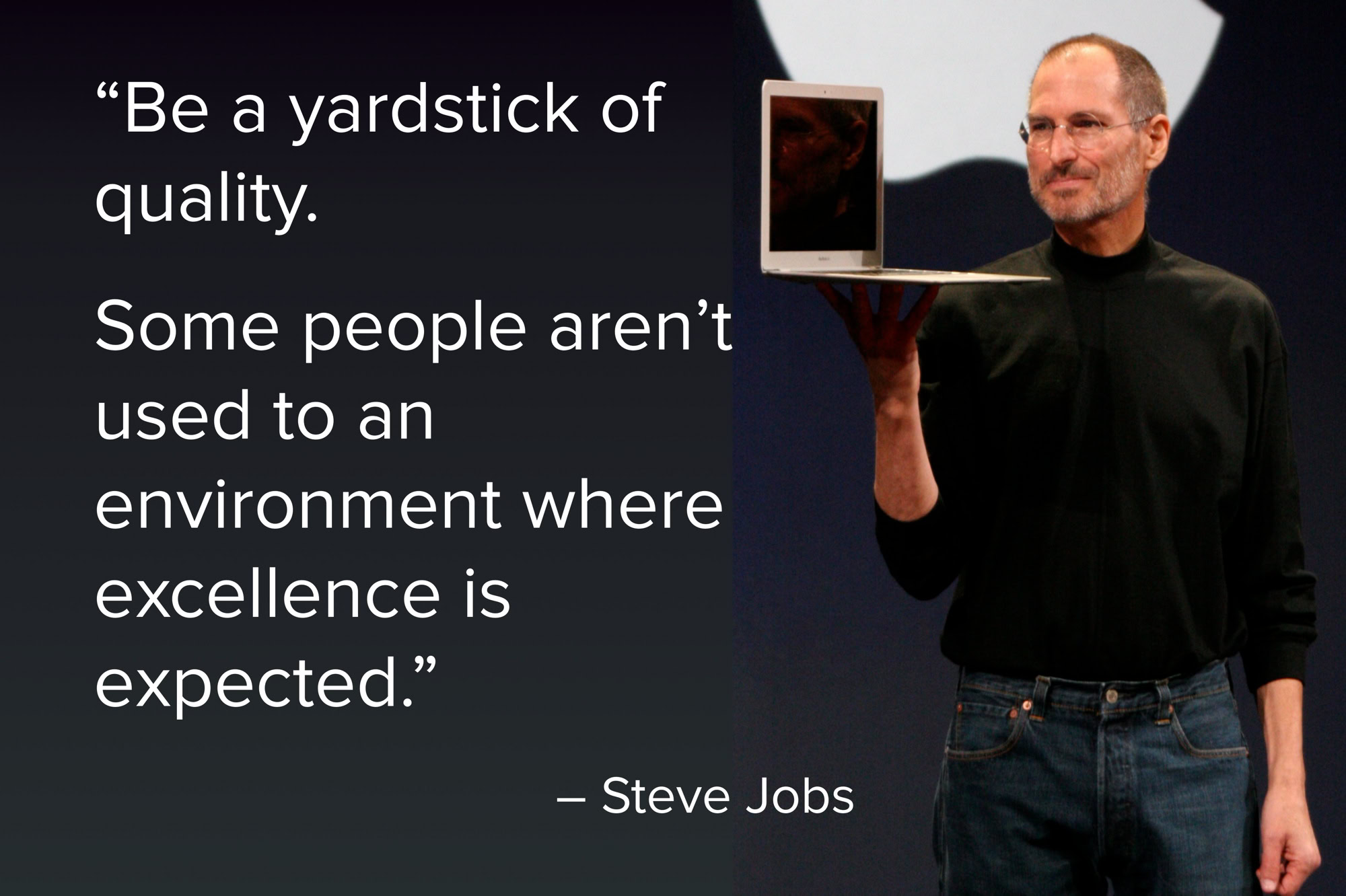
Steve Jobs, the founder of Apple Computer, shared a very perceptive insight on why this might be so several decades ago. Speaking in December 1991, Jobs said:
“It’s funny. The group of people who do not use quality in their marketing are the Japanese. You never see them using quality in their marketing. It’s only the American companies that do. And yet, if you ask people on the street which products have the best reputation for quality, they will tell you it’s the Japanese products. Now why is that? How could that be? The answer is that customers don’t form their opinions on quality from marketing. They don’t form their opinions on quality from who won the Deming Award or who won the Baldrige Award. They form their opinions on quality from their own experience with the products or the services. And so, one can spend enormous amounts of money on quality. One can win every quality award there is. And yet, if your products don’t live up to it, customers will not keep that opinion for long in their minds. And so, where I think we have to start is with our products and our services, not with our marketing department. And we need to get back to the basics and go improve our products and services”.
Although Steve Jobs was talking about quality in general, his words are highly pertinent to schools, even though his primary focus at the time was marketing home computers.
When I was working as a Head of School, and subsequently in my consulting work with school boards and leaders, one enduring truth has been reinforced over and over again: the most powerful way to market a school’s quality and attract enrolment applications is through spontaneous, genuine, unrehearsed word-of-mouth comments from current parents: comments that are shared with parents of other children at occasions such as children’s birthday parties. If we express this in “marketing speak”, we could quote Scott Cook (the co-founder of software company Intuit) and say that “a brand is no longer what we tell the consumer it is; it is what consumers tell each other it is”.
Whether we are talking about schools, software companies, computer manufacturers or any other organisation from an alumni association to a zoological society, quality refers to the culture of the organisation, not its marketing. If schools ensure that the quality of education being provided to its students is first-rate, meeting and hopefully exceeding the legitimate expectations of children and their parents, then the marketing should take care of itself – and it should do so without the help of any expensive marketing consultants.
- Dr Stephen Codrington
Additional insights into the themes explored in this article are found in Branding.
We offer support for school leaders and board members (including Board Chairs) in many ways, including through workshops for boards and school leaders.
Further information on this and many other facets of best practice in school leadership and governance is provided in the books “Optimal School Governance", and “DARING INSIGHTS into School Leadership and Board Governance”, which can be ordered directly through Pronins.
You may also be interested in previous articles which are archived at https://optimalschool.com/articles.html. You can subscribe to receive future articles by e-mail using the red button below.