


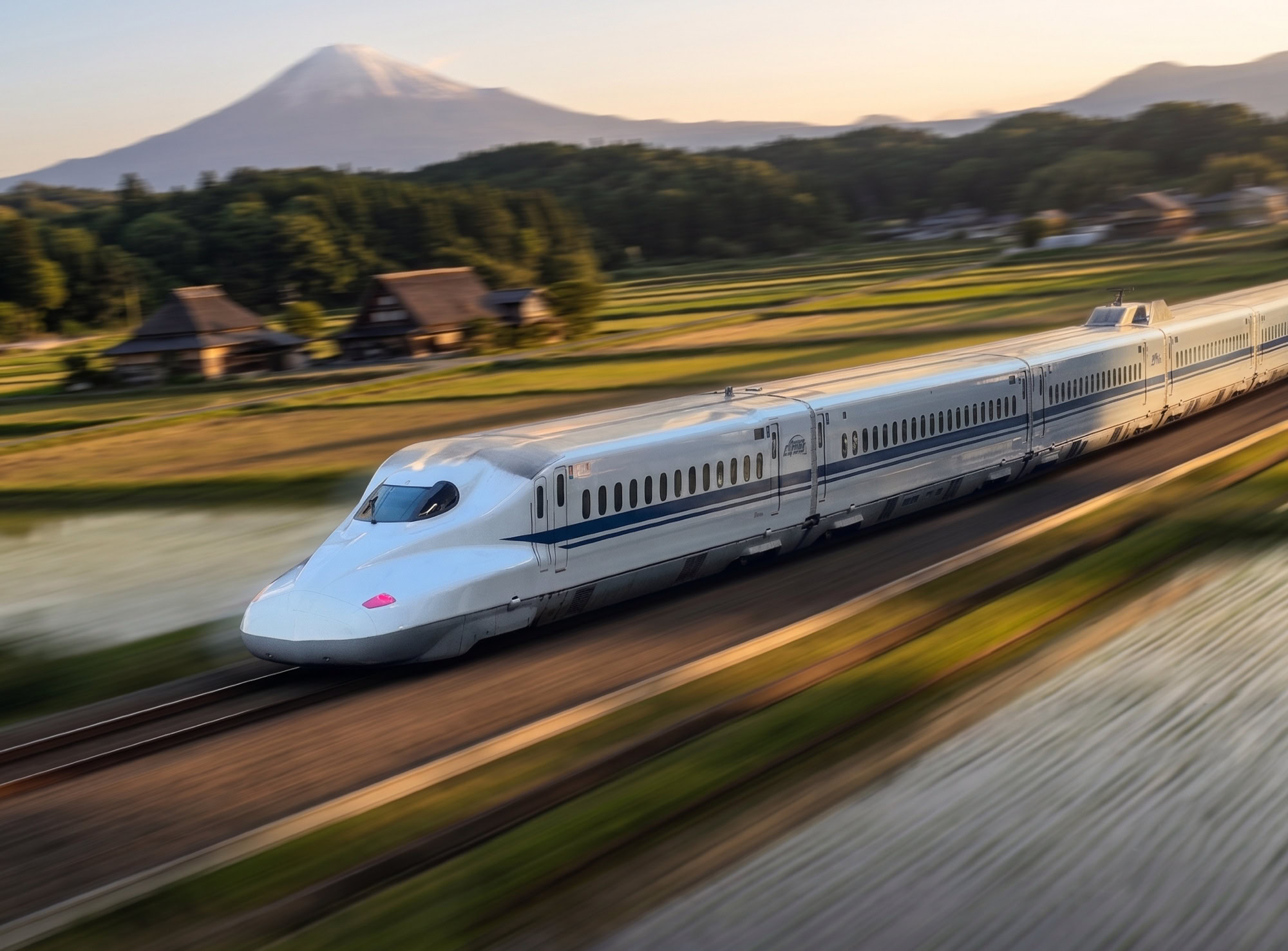
If you believe “the internet”, there is an ancient Japanese proverb which says “If you get on the wrong train, get off at the nearest station. The longer it takes you to get off, the more expensive the return trip will be”.
Given that trains are not ancient inventions that typically appear in age-old wisdom, and knowing that the first train did not appear in Japan until 1872, I checked the origin of the proverb. I found that no historical record, no classical Japanese text, and no traditional ‘kotowaza’ (Japanese idiom) contains any reference to getting off a train. Eventually, I learned that the quote actually originated much more recently, specifically on several self-help websites and motivational podcasts as recently as late 2024. It later spread widely across Instagram, Facebook and LinkedIn in 2025 and 2026 as a meme attempting to frame a modern life-advice perspective as ancient, exotic wisdom.
The proverb is intended to convey the idea that many professional people remain in the wrong work environment far longer than they should. It is an allegory for the “sunk cost fallacy” as it applies to work and careers, signifying that the inertia of lingering in a bad situation only exacerbates the cost and pain of eventual escape. The actionable consequence of this advice is that fixing a career choice mistake (or any mistake) early will cost less than trying to fix it later.
This proverb is clearly not ancient wisdom, but it may still represent good advice.
If work is exhausting you rather than energising you, if you are stagnating rather than developing as a person, or if you can’t see the ‘grand purpose’ of your work, then it is possible that you are approaching an inflection in your career. In such cases, the longer you remain in a wrong environment, the more difficult and painful the inevitable departure becomes.
This is relevant for school leaders because recent research suggests that many school principals (Heads of Schools) are experiencing sharply declining levels of work satisfaction. A 2025 study found that more than half (53.2%) of Australian school principals intend to resign due to worsening levels of physical violence, threats, and bullying. More disturbingly, this figure jumped to 82.3% for those with low job satisfaction. An even higher percentage of principals who indicated their intention to resign because of low job satisfaction reported severe anxiety. The main reasons given for dissatisfaction were escalating demands (especially by demanding or entitled parents and surging rates of student behavioural issues), administrative burden (especially by compliance and registration authorities), and systemic strain (due to underfunding and lack of professional support that were leading to burnout).
As I outlined in my article Is board governance in your school is working perfectly?, school boards have a critically important role to play in supporting their principals. In that article, I described the results of a 2025 survey by the Council of International Schools (CIS) showing that the biggest professional challenge faced by school principals was not escalating demands, administrative burden or systemic strain, but “school governance”. The study of almost 500 principals from 103 countries identified “board governance” and “corporate governance/ownership” as their biggest professional challenges.
This should concern every member of every school board. Peter Fonagy, Director of the Anna Freud Centre in London, wrote “An adverse event becomes traumatic when it is accompanied by a sense that one is not accompanied”. Trauma is a strong word to use in the context of a school principal who feels unsupported by the board, but it seems appropriate as the documented symptoms of trauma include hopelessness, disconnection, alienation, suspicion, lack of trust and powerlessness – all of which are words I have heard school principals express to me in my work with them when they are describing their relationship with their board.
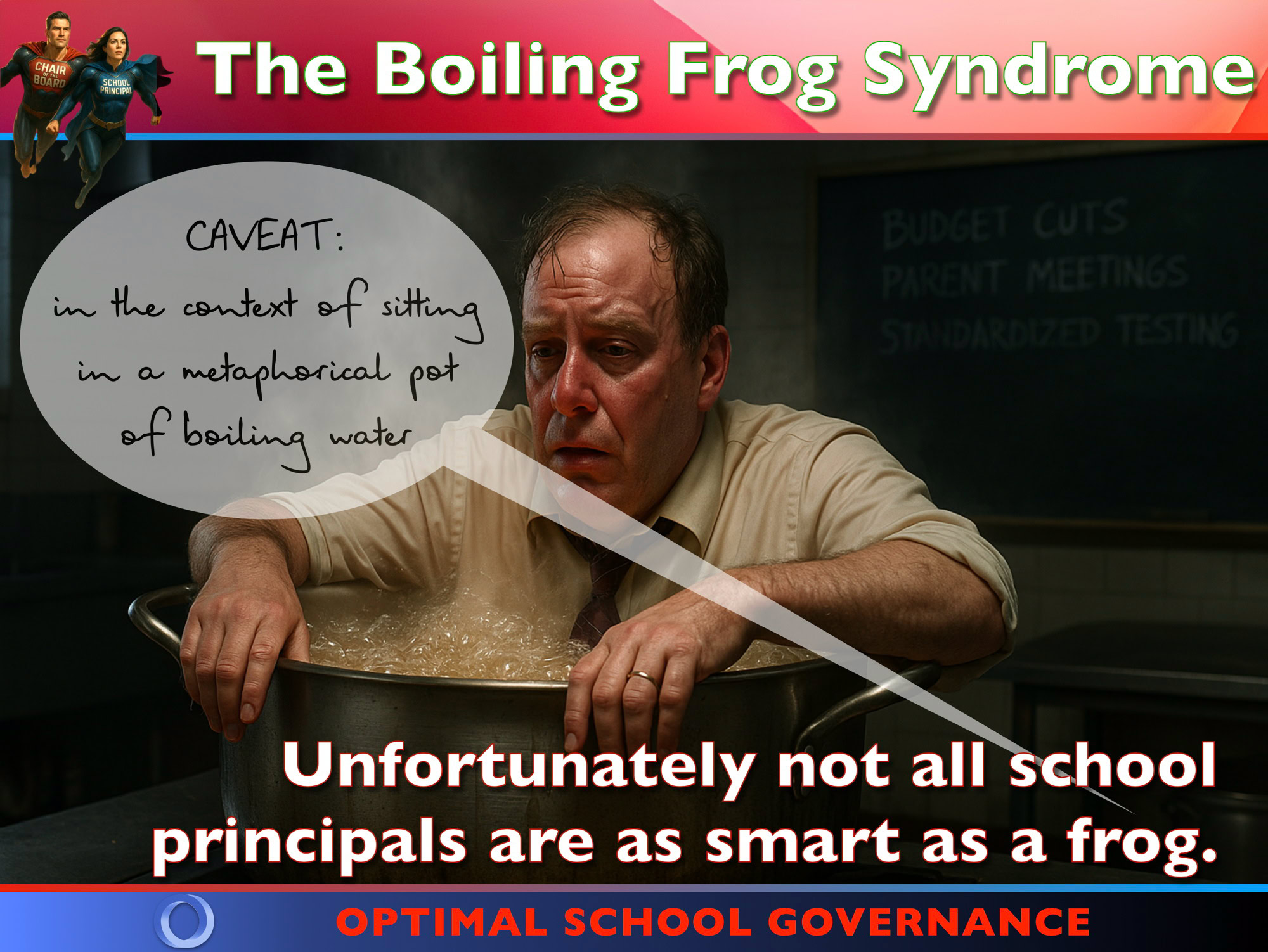
Whether or not you have come across the Japanese train proverb, I am sure you have come across the boiling frog syndrome. The assertion is that if you place a frog in boiling water, it will jump out immediately. However, if you place the frog in cold water, and gradually boil it, it will sit there and boil to death. Like the Japanese train metaphor, the implication is that if you are in a situation where the ‘temperatures’ (stress levels) rise slowly, you will tolerate the uncomfortable situation to the point of being boiled alive.

It is a myth. Frogs are actually smarter than that, and they will jump out of a pot of water that is being warmed up long before it reaches boiling point.
Unfortunately, not all school principals are as smart as those frogs. Too many principals remain in their positions, tolerating all kinds of unjustified and unjustifiable stresses and pressures from their boards, from government authorities, from disloyal staff, from entitled parents, from alumni, and so on, to the detriment of their physical health, mental wellbeing, family life and often their future career prospects.
For the record, I am not saying that I have ever met any school principal who I believe has less intelligence than a frog – except in the sole context of sitting in that metaphorical pot of boiling water.
The departure of a School Principal is among the most expensive and consequential events a school can experience. The costs of replacing a school principal are almost always under-estimated by school boards. That is why my next article will outline and explain the scope of these costs.
- Dr Stephen Codrington
We offer support for school leaders and board members in many areas, including workshops and direct support on the relationship between the Board and the Principal, and 360-degree Principal Performance Reviews.
Further information on this and many other facets of best practice in school leadership and governance is provided in the books “Optimal School Governance", and “DARING INSIGHTS into School Leadership and Board Governance”, which can be ordered directly through Pronins.
You may also be interested in previous articles which are archived at https://optimalschool.com/articles.html. You can subscribe to receive future articles by e-mail using the red button below.