


School Boards and their Principals today are drowning in an unprecedented ocean of burdensome bureaucracy and government compliance.
This conclusion is not only based upon my observations while working with school leaders and boards in multiple countries, but on countless direct comments that heads of schools and board members have made to me. In my work with schools, it seems clear that every year brings another demand for external compliance, additional reporting requirements, another audit, another mandatory training program or another regulatory framework demanding attention.
Frankly, escalating bureaucracy is a real and rising barrier to finding willing and able applicants for Principals’ positions, and also when trying the recruit new members for school boards. It is a global phenomenon, it is relentless, and the problems it causes are escalating.
To be fair, these externally imposed demands are usually well intentioned. They are designed to address a plethora of important areas such as child protection requirements, workplace health and safety, privacy and data protection, risk management, financial reporting, employment legislation, industrial relations, disability and inclusion obligations, ethical use of AI, cybersecurity, emergency management, mandatory reporting, accreditation requirements and increasingly complex registration standards.
All these have legitimacy. The problem is not that any one of these requirements is necessarily unreasonable. The problem is their cumulative weight. Each additional obligation may appear modest when considered in isolation, but together they create a bureaucratic ordeal that increasingly consumes the time and energy of the people who are supposed to be leading the school. Those who are entrusted with giving direction to the school (the Board and the Principal) are the ones who must divert their attention away from leadership to bureaucratic priorities imposed by external agencies.
For the Principal, this creates a particularly dangerous distortion of priorities. Contrary to the view of many politicians and bureaucrats, a Principal’s most important work is not completing compliance registers, responding to regulators, reviewing policies, documenting risk assessments, preparing audit evidence, attending mandatory training, signing off procedures, completing increasingly elaborate reports or sitting in meetings about compliance.
The Principal's work is leading the school and its people. This is not a simple task. It involves aligning the school’s direction with the Board’s mission and vision, building intentional culture, knowing and inspiring the students, supporting teachers, developing leaders, employing (and dismissing) staff, talking with parents, resolving operational challenges, directing and improving the quality of teaching and learning, managing resources and ensuring that the school operates effectively.
And yet, bureaucratic demands have a remarkable capacity to fill the Principal’s diary. A morning set aside for classroom visits can disappear into filling in a detailed, highly granular report on the demographic structure of the teaching staff. Time allocated to mentoring a senior leader can be consumed instead by an employment matter or regulatory submission. An afternoon that should have been spent talking with students and staff becomes another sequence of e-mails, forms, risk assessments and compliance meetings. Rather than building the relationships that enable the school to run cohesively, the Principal is locked away under a growing pile of accountability reporting.
The tragedy is that much of this work is invisible to the school community (including even the Board), and yet the opportunity cost is enormous. Every hour the Principal spends documenting that the school is doing the right thing is an hour that cannot be spent on tasks that genuinely improve the school.
The same phenomenon is increasingly affecting school boards. Boards have a fundamental duty to ensure that the school is properly governed, has a clearly articulated mission and vision, is financially sustainable, is legally compliant and is appropriately managed. However, governance can all too easily become compliance theatre, becoming bogged down in approving policies, reviewing registers, receiving risk reports, checking audit recommendations, monitoring regulatory requirements and satisfying procedural obligations.
Board agendas thus become progressively longer while the time available for genuinely strategic conversation becomes progressively shorter. Board members can spend an entire meeting discussing whether the school has the appropriate policy, procedure or risk control while barely finding time to ask the questions that will determine the school’s future such as “What will our school need to look like five or ten years from now?”, “What will our students need to learn to thrive in society in the future?”, “What threats could fundamentally disrupt our model?”, “How will artificial intelligence change education?”, “What kind of teachers and leaders will we need?”, “How will demographic, economic and geopolitical changes affect enrolments?”, “Where should we invest, and as a corollary, what should we stop doing?”. These and hundreds of similar questions can only be properly addressed by a board that has sufficient time to engage in generative discussions. Sadly, they are precisely the questions most easily squeezed out by an agenda dominated by compliance.
This raises a wider question for school boards. How can a school board ensure that it is meeting its externally imposed obligations while giving due priority to the real tasks of effective governance? The simple answer is “spend more time” or have longer meetings”, but almost every school board I have observed comprises time-poor, over-committed members who are already generous with the time and energy they devote to the school. Demanding an even greater commitment of time and energy might simply be a speedy way to depopulate the board!
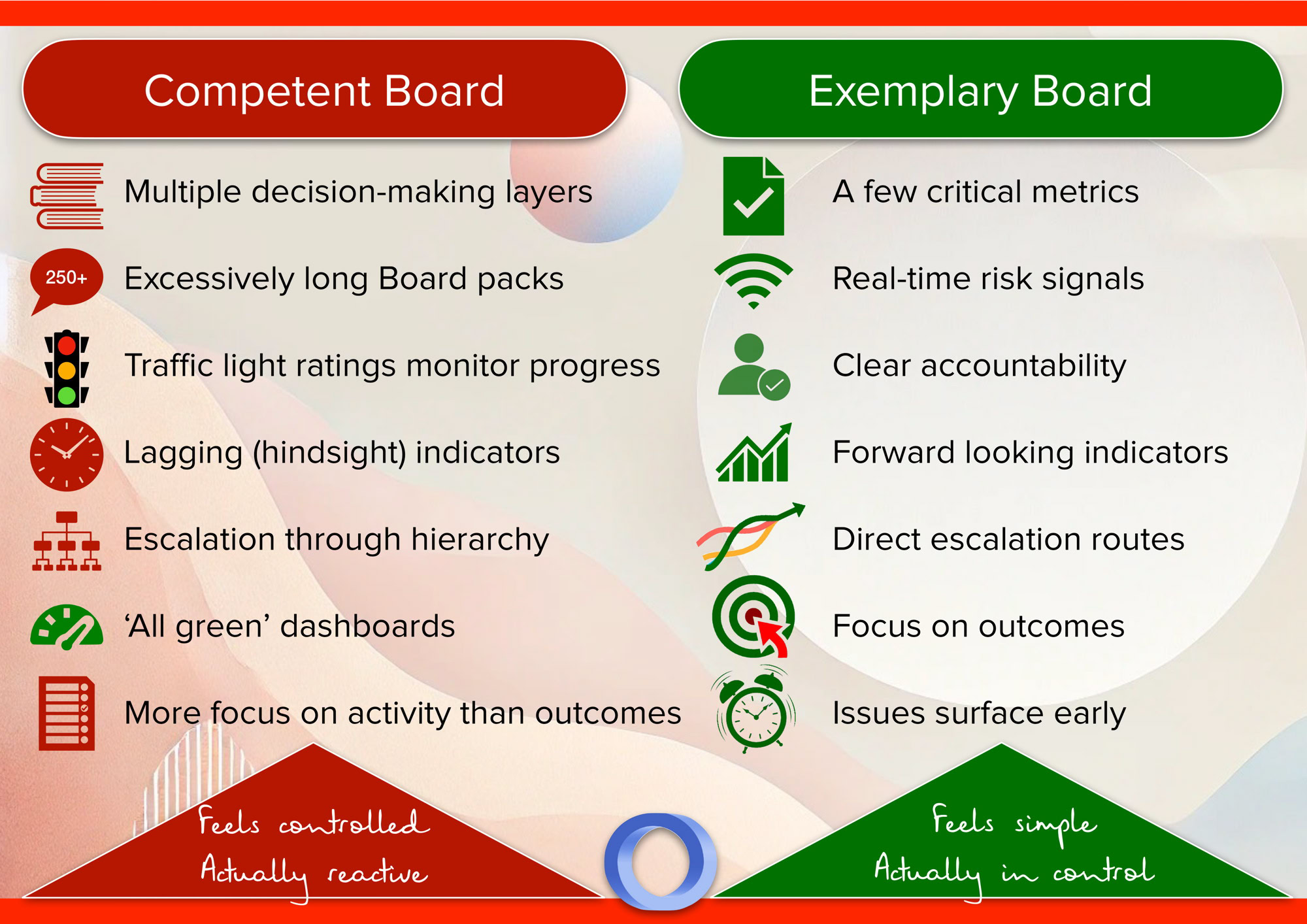
For Boards, an important part of the solution is using meeting time as efficiently as possible. The days are long past when attendees can afford to spend hours at every meeting sitting around and “chewing the fat”. Competent boards have achieved greater efficiency of time by adopting techniques such as dashboards to monitor important trends and statistics, and a ‘traffic lights’ system to label agenda items as being “taken as read” (green light), “requiring discussion but not a decision” (amber light), or “requiring a decision” (red light), and allocating time accordingly.
Exemplary boards take time-efficiency even further. They focus on statistical data that looks forward to the future rather than simply following relying on hindsight data that shows past trends. They streamline decision-making processes, focus on a small number of critically important outcomes with clear lines of delegation and accountability, and track data (as far as possible) in real time. Exemplary practice looks surprisingly simple, but it provides the board with authentic control rather than an illusion of control.
For School Principals, using time efficiently is (and always has been) of central importance in coping with heavy and growing workloads. A vital component of efficient time management is ensuring that Principals have highly capable senior staff (such as an Executive Assistant in addition to a Personal Assistant) to whom important, time-consuming, bureaucratic tasks can be delegated.
Whether we are focussing on Boards or Principals, a profound paradox at work. The more time leaders spend managing bureaucracy, the less time they have to lead. The more time Boards and Principals spend looking backwards to demonstrate that obligations have been satisfied, the less time they have to look forward and shape the future.
Compliance is necessary and accountability is essential. Financial probity and fulfilling legal obligations cannot simply be ignored. However, a school can become so preoccupied with demonstrating that it is compliant that it loses sight of why it exists in the first place. The solution is not to abandon compliance but to become much more disciplined about it by streamlining reporting, eliminating duplication, delegating operational compliance appropriately, using technology intelligently, establishing clear thresholds for board involvement, and ensuring that every board meeting protects substantial time for strategic discussion.
The board should not be the school’s chief compliance committee, and a Principal should not become the school’s chief compliance officer. Their scarce leadership capacity should be reserved for the work that matters most, which in any school is leading people, setting direction, improving total quality, and preparing it courageously for the future.
- Dr Stephen Codrington
We offer support for school leaders and board members in many areas, including providing critical friendships and mentoring for School Principals and Board Chairs, conducting board performance reviews, and conducting Head of School (Principal’s) evaluations and performance appraisals.
Further information on this and many other facets of best practice in school leadership and governance is provided in the books “Optimal School Governance", and “DARING INSIGHTS into School Leadership and Board Governance”, which can be ordered directly through Pronins.
You may also be interested in previous articles which are archived at https://optimalschool.com/articles.html. You can subscribe to receive future articles by e-mail using the red button below.