



Creativity and school boards – are they compatible?

A school board’s creativity is not chaotic, but a structured, powerful force that cultivates a vibrant future. The landscape should feel real, awe-inspiring, and metaphorically rich. 1. OVERALL COMPOSITION & LIGHTING Format: Landscape (16:9 ratio), cinematic width. Time of Day: "Golden Hour" – late afternoon. The sun is low, casting long, defining shadows and bathing the scene in warm, hopeful light. This symbolizes clarity, insight, and the culmination of a day's work. Light Source: The sun is positioned slightly off-centre to the right, creating directional light that highlights textures and depth. Mood: Serene, powerful, orderly yet dynamic. The feeling should be one of guided potential. 2. THE PRIMARY LANDSCAPE: "THE BOARDROOM AS TERRAIN" Foreground (The Discussion): Beside a meeting of school board members, a wide, clear river splits into multiple, ordered channels as it flows toward the viewer. Each channel is distinct, carving its own path through smooth stone. The water is not chaotic; it is purposeful, reflecting the golden light. This represents the creative flow of discussion—diverging ideas that are still part of the same source and goal. Midground (The Decision-Making): The river channels converge into a single, powerful waterfall that cascades into a large, calm lake. The waterfall is the focal point—a decisive, energetic action. The mist at the base catches rainbows. This represents the moment of decision, where creative options synthesize into a clear, impactful outcome. Background (The Foundation & Vision): On the left, a solid, weathered cliff face with visible, stratified rock layers. On the right, a lush, vibrant forest with diverse tree species (oaks, pines, aspens). The cliff represents policy, precedent, and stability. The forest represents growth, diversity of thought, and the community. The Lake (The Impact): The calm lake in the midground perfectly reflects the sky and a distant school building (see below). Its surface is mostly still, with gentle ripples from the waterfall's influence. This represents the reflective, lasting impact of decisions on the school environment. 3. KEY SYMBOLIC ELEMENTS (Subtle & Integrated) The "School": To the left of the board members meeting, the school is nestled where the forest meets open field, is a modern, welcoming school building. Its windows glow with the same golden hour light. It is not dominant in size, but is the clear destination of the landscape's flow. The "Board Table": In the immediate foreground, slightly off-centre, the rock formation should subtly resemble a polished, natural stone table. On it, place 5-7 smooth, unique stones of different types (granite, quartz, slate) arranged as if in mid-conversation. One has a fossil visible (connecting to history/legacy). The board members are seen behind the table looking down towards the stones on the table. Wildlife: A great blue heron stands poised and watchful at the edge of the waterfall's pool (symbolizing wisdom and focus). A flock of birds (like starlings) flies in a gentle, coordinated pattern over the forest (symbolizing collaboration and big-picture thinking). The "Data Stream": Along one of the smaller river channels, have fallen autumn leaves floating, forming a gentle, curving line like a graph or chart. They are part of the natural scene, not an imposed graphic. 4. PHOTOREALISTIC STYLING & DETAIL Textures: Ultra-sharp detail on wet rocks, individual pine needles, water droplets in the mist, bark texture. Water: Render the water with perfect realism—translucent in the channels, turbulent and white at the falls, mirror-like in the lake. Atmosphere: Use subtle volumetric light (god rays) filtering through the trees on the right and light mist rising from the waterfall basin. Color Palette: Warm Golds & Ambers: On the cliff faces, tree trunks. Deep Greens & Blues: In the forest shadows and the deep pool. Vibrant Accents: The rainbow in the mist, a few bright wildflowers (like blue lupine) at the forest edge. The overall tone should be harmonious and natural, leaning toward the enhanced beauty of fine art photography. 5. FINAL ARTISTIC DIRECTION Viewpoint: Low angle, giving the landscape a monumental, majestic feel. Depth: Strong sense of depth leading the eye from the detailed foreground stones, along the river, to the impactful waterfall, and finally to the calm lake and school. Title for Inspiration: "Confluence of Thought" Goal for the Viewer: They should feel a sense of awe at the natural order, then slowly recognize the metaphor. The image should communicate that creative, divergent discussion (the channels), when channelled through good governance (the riverbanks), leads to powerful, beautiful, and reflective outcomes (the waterfall and lake) that nourish the future (the school, the forest).

Yes, creativity is a positive, and arguably essential, attribute for school boards.  This is because creativity provides the foundation for the visionary leadership and effective problem-solving that are so important in today’s increasingly complex educational environments. 

Creativity is a positive attribute for school boards because it encourages:

Of course, creativity is notoriously difficult to measure in schools, and even more difficult to define when it applies to school boards.  Ideally, school boards should identify and measure the success of creative initiatives in the school through a multi-faceted approach that balances qualitative evidence (measurements) with quantitative metrics (anecdotes, stories and actual experiences of students and teachers).  Because creativity is complex and often shows itself in new, highly original, sometimes unpredictable ways, effective evaluation must move beyond standardised test scores (which tend to over-value the uniformity of prescribed outcomes) to assess the processes, the environment, and the outcomes of innovative practices. 

Rather than measuring “creativity” as a single score, boards can track shifts in student engagement and the development of creative habits such as:

Boards can also use Key Performance Indicators (KPIs) to ensure the “institutional culture” supports creativity, such as:

For specific projects, boards can monitor more formal assessment techniques to judge the quality of creative output, such as

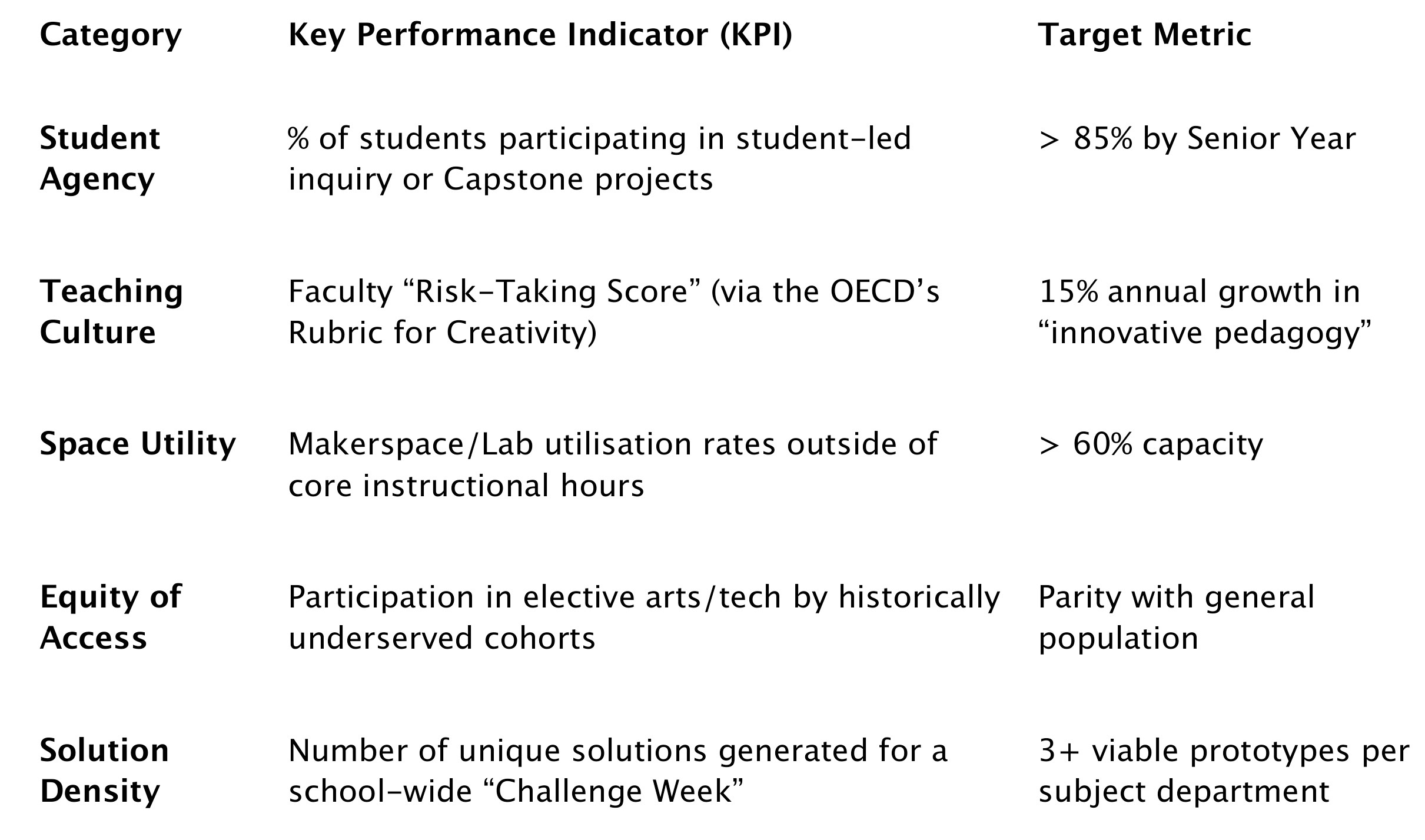
A sample KPI dashboard that a creatively-focussed Board might use internally to monitor creativity in the school could look something like this:
A comparison of values terminology used in the UK and the US.

Related to this dashboard, the school’s teachers might adapt their reports to parents to communicate non-traditional metrics of creativity through:

Having made the case that creativity is an almost essential characteristic for a school board to maximise its positive impact, there are of course specific situations where a responsible school board must prioritise stability, compliance, and predictability over creativity and innovation.  Straying excessively into “creative” territory can expose the board to legal, financial, or operational friction, and in extreme cases, illegitimate activities.

School boards operate within a rigid framework of government legislation and accreditation (or registration) standards. “Creative” interpretations of mandatory policies can lead to significant risk.  For example, standard operating procedures for student safety (such as fire codes and lockdown drills) require absolute uniformity and adherence rather than creative variation.  Furthermore, as school boards are often stewards of public funds, private donations and parents’ fees, government regulations mandate strict reporting standards where “creative accounting” is a legal liability.

Excessive or rapid creative change can also result in a destabilisation of the school’s culture and morale, and destabilise the school’s workforce.  If a board is constantly pivoting to the “next creative idea”, it can lead to initiative fatigue among teachers and staff.  Incessant change for its own sake will prevent any single strategy from being properly embedded or measured.  Research on school improvement suggests that consistent focus on the school’s clear mission and vision is always more effective than novelty, and a board that is too “creative” may overwhelm staff with too many competing, incompatible priorities. 

To sum up– creativity is almost essential for school boards to function effectively and ‘add value’ to the school, but it must be tempered by mature attention to legal, financial, and cultural constraints.

– Dr Stephen Codrington

We offer support for school leaders and board members in many areas, including workshops on Board operations which are supported by our independent Board performance reviews.

Further information on this and many other facets of best practice in school leadership and governance is provided in the books “Optimal School Governance", and “DARING INSIGHTS into School Leadership and Board Governance”, which can be ordered directly through Pronins.

You may also be interested in previous articles which are archived at https://optimalschool.com/articles.html. You can subscribe to receive future articles by e-mail using the red button below.