


A member of the school board is working for a company which has a side business running after-school coaching clinics that compete with the school’s own support programs.
A member of the school board is in a romantic relationship with the principal’s spouse.
A member of the school board is showing favouritism to a supplier by allowing them to short-circuit the normal bidding process.
An employee of the school is using the school’s database to send e-mails to parents advertising their spouse’s business.
A member of the school board has made a very substantial donation to the school’s building program and is now demanding regular input to influence the day-to-day operations of the school.
These (and thousands of other potential situations) are examples of conflicts of interest. A conflict of interest arises when a board member’s personal or financial interests interfere, or appear to interfere, with their duty to make impartial decisions for the benefit of the school. These conflicts can take many forms, from awarding contracts to businesses owned by relatives, to making decisions that financially benefit a board member’s own ventures. When such conflicts are not disclosed or managed properly, they erode public confidence and may even result in legal consequences or the invalidation of board decisions.
Conflicts of interest fall into four broad categories: financial, competitive, romantic or relational, and confidentiality. Unfortunately, they are a fairly common source of problems in schools, especially on school boards.
Failure to address conflicts of interest is illegal in many (but not all) countries. They are addressed in the laws and regulations of many countries, including almost all international bodies, most European Union member states, the United States, the United Kingdom, Australia and Canada. While many other countries recognise the importance of addressing conflicts of interest, they don’t necessarily criminalise them.
In many countries, conflicts of interest are treated as administrative misdemeanours. This means that the laws governing conflicts of interest usually have relatively low standards of proof, and so the penalties for non-compliance are likely to be less severe than the consequences for related criminal offences. In some countries, organisations and individuals are simply expected to identify, declare, and manage conflicts of interest. It should be noted, however, that the regulatory bodies and accreditation agencies which set standards for schools usually take a stronger stand against conflicts of interest and demand that they be handled according to prescribed policies and procedures.
As discussed briefly in AI, ChatGPT and the future of education and Free Riding, transparency and accountability are of central importance in addressing conflicts of interest. For example, if a board member owns or is associated with a construction company bidding on a school building project, that board member must be required to declare this interest and abstain from any discussions or votes related to the contract.
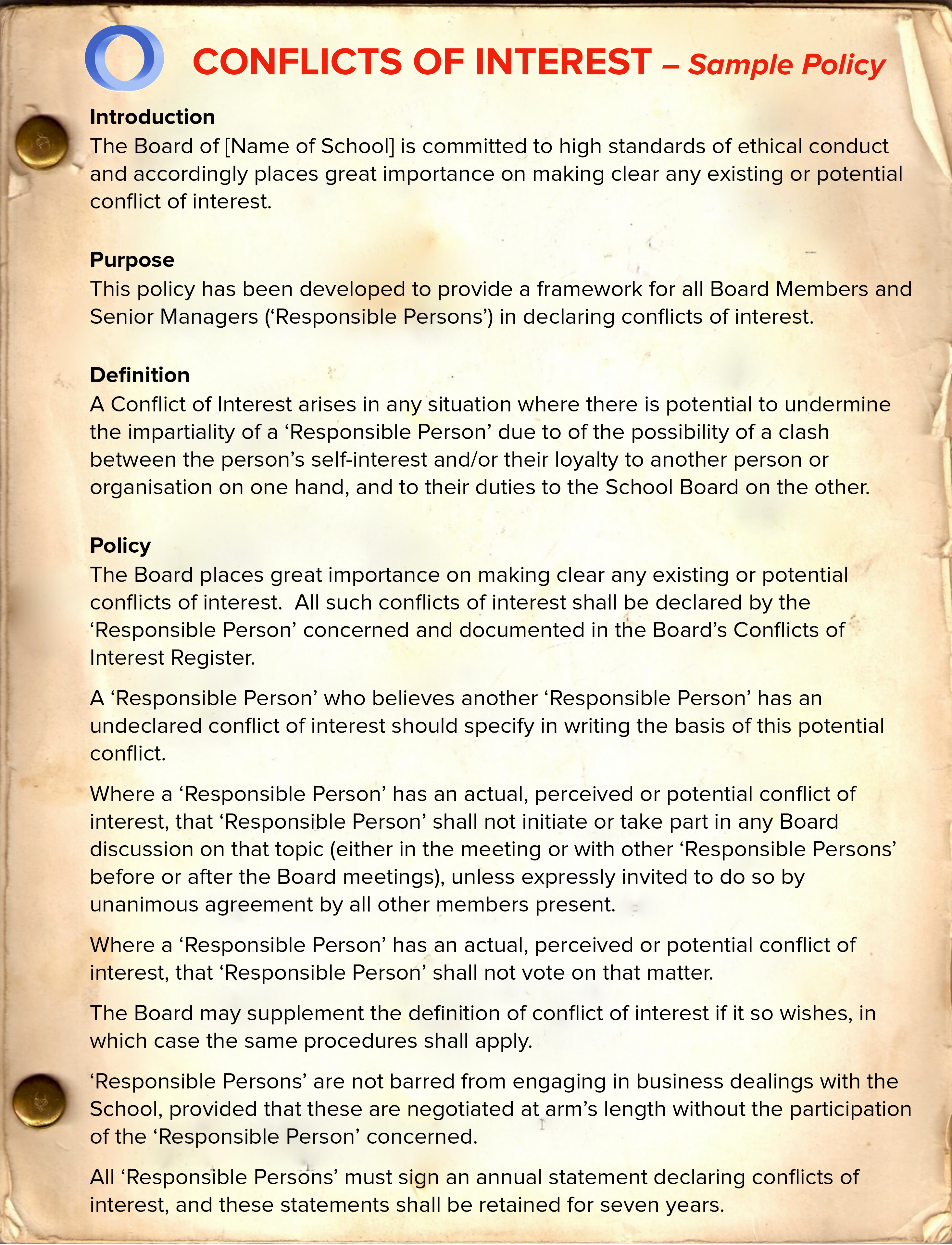
Schools (and their boards) are expected to adopt and enforce comprehensive policies and practices to handle conflicts of interest. These should include clear definitions of what constitutes a conflict of interest, detailed procedures for disclosure, and strict rules for recusal from discussions on related matters during board meetings. Training sessions on ethics and transparency are important as part of the induction program for all new board members, and they should be repeated for all board members periodically. An example of a basic, abbreviated Conflicts of Interest Policy is shown below.
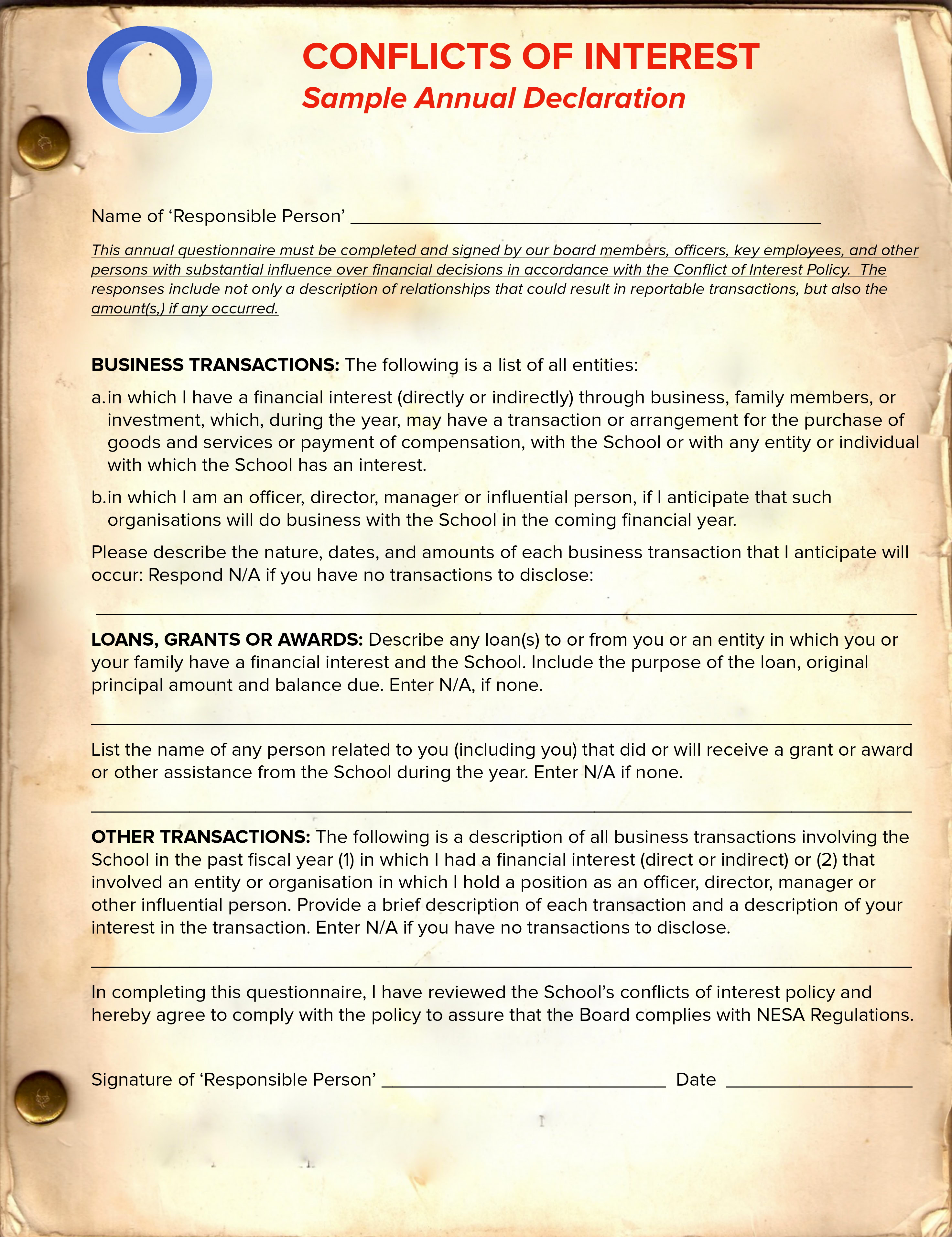
Transparency is essential for handling potential conflicts. To this end, it is good practice for all board members to sign an annual declaration of their actual, potential or perceived conflicts of interest as an outward sign that they are aware of the policy and have considered any changes to their previously stated positions. These declarations should be kept on file in case of challenges to board decisions or questions from registration and accreditation authorities.
If an undeclared conflict of interest is discovered after a decision has been made, school boards must act promptly and transparently to rectify the situation. This could involve rescinding contracts, conducting internal investigations, or even removing board members from positions of influence. Legal advice should be sought to determine the appropriate course of action, especially if laws may have been violated. Boards must communicate clearly with their stakeholders about their response to such conflicts to rebuild trust and demonstrate accountability.
Ultimately, avoiding and addressing conflicts of interest is not just a matter of compliance – it is a cornerstone of effective and ethical governance. School boards must remember that they are stewards of the resources they control, and members must always place the school’s interests above all else when they are making decisions about the school in board meetings. By taking proactive steps to prevent conflicts of interest, responding swiftly if and when they arise, and modelling ethical behaviour, school boards can fulfil their mission with integrity and earn the trust that is essential for their effective service to the school’s community.
- Dr Stephen Codrington
We offer support for school leaders and board members in many areas, including workshops on conflicts of interest and assistance for schools when crisis management is required.
Further information on this and many other facets of best practice in school leadership and governance is provided in the books “Optimal School Governance", and “DARING INSIGHTS into School Leadership and Board Governance”, which can be ordered directly through Pronins.
You may also be interested in previous articles which are archived at https://optimalschool.com/articles.html. You can subscribe to receive future articles by e-mail using the red button below.