

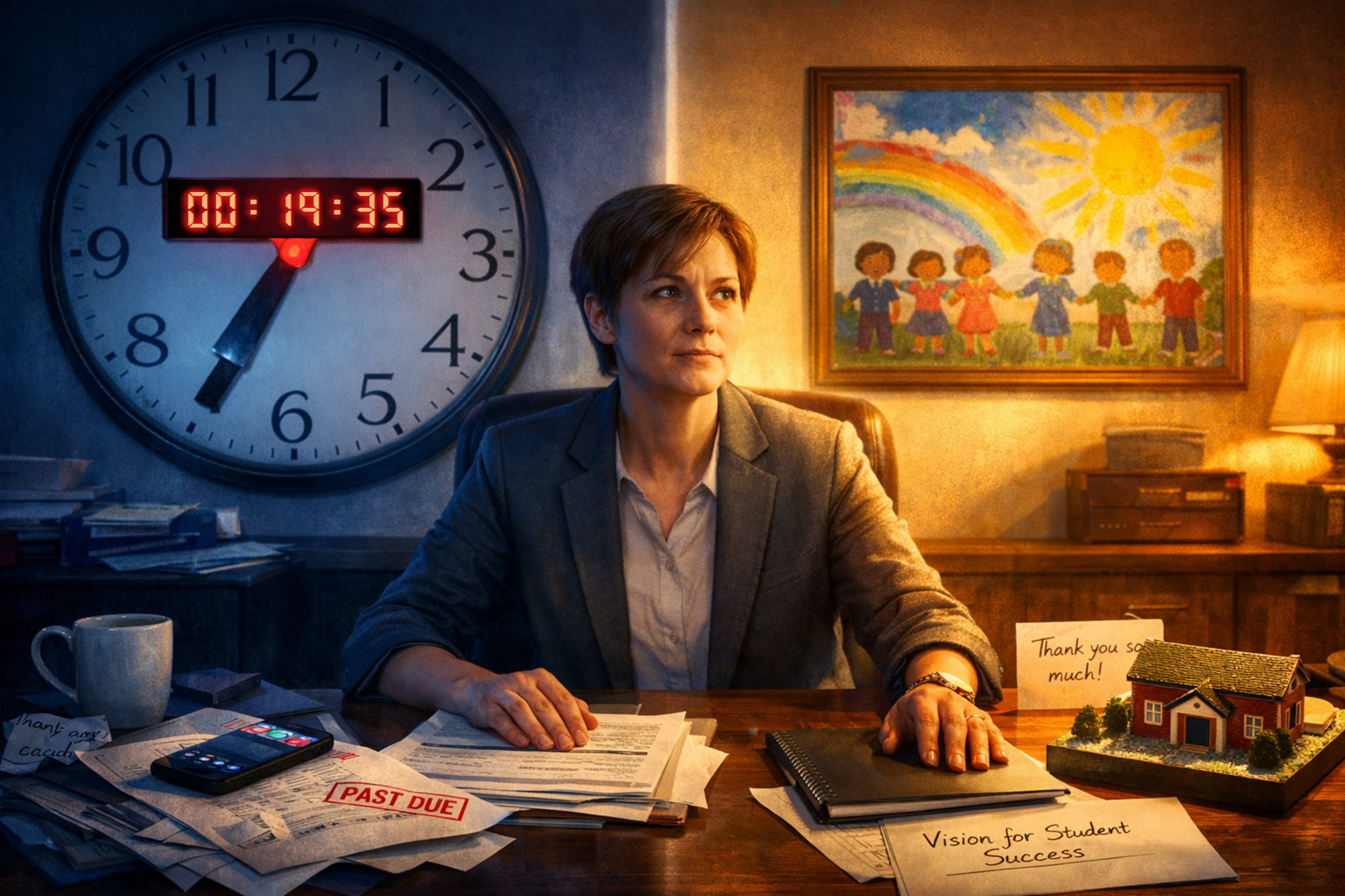
Do you think you do your best work under pressure, such as when you have a tight deadline to meet?
If your answer is “yes”, then you are in a solid majority of the population. Surveys suggest that more people believe their creativity is enhanced by working to a tight timeline than not. In this respect, school leaders and board members mirror the wider population.
A landmark 10-year study called “Creativity under the Gun” published by Harvard Business School in 2002 investigated instances where working under extreme pressures of time had produced impressive results, a notable example being the astronauts trying to save the Apollo 13 spacecraft. Starved of oxygen due to a technical malfunction, the three astronauts needed to develop an improvised system at breakneck speed to remove deadly carbon dioxide from the air in their module using only the items available to them – a few pieces of cardboard, some plastic bags and a roll of electrical tape.
The astronauts succeeded. However, when the authors of the Harvard study (Teresa M. Amabile, Constance Noonan Hadley and Steven J. Kramer) finished studying 9,000 diary entries from 177 employees across seven US companies, they arrived at a more nuanced overall conclusion. They found that “some people are convinced that time pressure stimulates creative thinking, and others are certain it stifles creative thinking”.

The authors’ analysis of diary entries in the study showed that people were actually 45% less likely to generate new ideas or solve complex problems on extreme-pressure days compared to low-pressure days. Furthermore, approximately 29% of creative professionals specifically cited tight deadlines as a major obstacle to free-flowing ideas. Overall, roughly 75% to 80% of workers felt that tight deadlines increased pressure to be productive rather than being able to be creative.
In a sad indictment of the 21st century workplace which many (if not all) school leaders can probably identify with, most of the diarists felt they were operating under time pressure nearly every day.
It is easy to understand why senior personnel in a school such as Heads and board members who feel they are working under intense external pressure are usually less creative. Working in a hurry often means firefighting and multitasking, scheduling back-to-back meetings, replying to emails, attending more meetings, answering still more emails, handling unforeseen complaints and crises, leaving precious little time to focus on the primary work tasks at hand. One comment in the Harvard study summed up most of the diarists’ entries: “The faster I run, the behinder I get.”
The Harvard authors contrasted the busy, everyday working environments such as schools, with situations that encourage genuinely productive creativity. Their article stated:
“Truly breakthrough ideas rarely hatch overnight. Consider, for example, Charles Darwin’s theory of evolution, which had a protracted evolution of its own. Darwin spent decades reading scientific literature, making voyages on the HMS Beagle to the Galápagos and other exotic destinations, carrying out painstakingly detailed observations, and producing thousands of pages of notes on those observations and his ideas for explaining them. It’s inconceivable that his breakthrough would have occurred if he’d tried to rush it”.
When time becomes tight, a sad reality is that the first thing to be discarded is usually creativity. In the Harvard study, a mere 5% of the many thousands of diary entries reported that any playful or creative work had been produced. The Harvard Business Review authors argued that creativity may be possible under tight constraints of time, but it is extremely rate and occurs only under very specific circumstances.
In other words, creativity under pressure, like that demonstrated by the Apollo 13 astronauts, is the exception rather than the general rule. They had to solve an urgent problem of lack of oxygen, and they were able to give it their sole attention. They were not distracted by multi-tasking, and their likely imminent deaths clearly focussed their attention and motivated them in a way that even the most highly pressured, overly stressed Head of School should (hopefully) seldom expect to experience.
But in most environments, including the types of high pressure, compliance-dominant situations experienced by school leaders and their boards, the Harvard authors concluded that the cornerstones of creative work – exploration, idea generation and experimentation – simply didn’t occur when workers were struggling to meet a tight deadline.
The research suggests strongly that we should not be seduced into thinking that the pressure of time will in itself stimulate creativity. This might be a powerful and commonly held illusion, but it is an illusion nonetheless.
Having made this point, we should remember that this research was undertaken a quarter of a century ago. Today, younger adults (18–24) and those from lower socio-economic backgrounds are less likely to view creative careers as viable compared to those over 55, so the challenge to be creative is perhaps viewed as being less important these days. This is reinforced by studies showing a sharp decline in creative confidence as people age: 98% of 5-year-olds display “genius level" creativity, dropping to 12% by age 15 and just 2% in adulthood.
UK-based research suggests that:
When we explore cultural settings beyond the US and UK, we begin to see see additional nuances affecting the issue of creativity in school leadership. Although it is a generalisation, it is fair to say that Atlantic cultures (such as the US and UK) are more likely to prioritise “novelty” and “breaking the rules” than (for example) East Asian cultures such as Japan, China and the Koreas, which often focus instead on usefulness, feasibility, and appropriateness.
In collectivist (as opposed to individualistic) cultures with strong social norms and low tolerance for deviance, individuals may be less likely to succeed at innovative creative tasks (and even less likely to attempt them in the first place), but they can be highly creative when working within the confines of their own cultural context. Indeed, in an Adobe ‘State of Creativity’ study, Japan was ranked as the most creative country by global peers, yet Japanese citizens were the least likely to view themselves as being creative.
Relating all this specifically to school board governance and leadership, the inevitable conclusion we must reach is that Boards will empower their Heads to be most creative when they allow enough time to complete tasks without undue pressure. Similarly, Heads will empower their staff to be most creative when they likewise set reasonable timeframes to complete tasks without undue pressure.
Amabile, Hadley and Kramer conclude their “Creativity under the Gun” article with these words:
“In short, the key to protecting creative activity—including your own—is to offset the effects of extreme time pressure. The obvious way to do that is to reduce the time pressure. But in cases where it is unavoidable, its negative effects can be softened somewhat by getting your people and yourself in the mind-set of being on a mission—sharing a sense that the work is vital and the urgency legitimate. It also means ruthlessly guarding protected blocks of the workweek, shielding staff from the distractions and interruptions that are the normal condition of organizational life.
The best situation for creativity is not to be under the gun. But if you can’t manage that, at least learn to dodge the bullets.”
- Dr Stephen Codrington
References:
Some specific techniques to help school leaders manage their time effectively are found in Time Management – juggling tasks, coffee cups, and late nights.
Teresa M. Amabile, Constance Noonan Hadley and Steven J. Kramer “Creativity Under the Gun” Harvard Business Review https://hbr.org/2002/08/creativity-under-the-gun
We offer support for school leaders and board members (including Board Chairs) through mentoring and critical friendships. We also support boards and School Principals through our senior management reviews, middle management appraisals and board performance reviews.
Further information on this and many other facets of best practice in school leadership and governance is provided in the books “Optimal School Governance", and “DARING INSIGHTS into School Leadership and Board Governance”, which can be ordered directly through Pronins.
You may also be interested in previous articles which are archived at https://optimalschool.com/articles.html. You can subscribe to receive future articles by e-mail using the red button below.